Some of you will remember the series I did on worship a while back. I explored a lot of different aspects of worship, from very practical to semi-theological vantages. And this past Sunday I was guest worship leader* for a local Vineyard. In fact my friend Tim was guest speaker and it was interesting the role the worship in song played in that service.
I had a wonderful backup musician, Nathan, playing djembe with me. We did a simple guitar/djembe combo for the music. That's the second time I've worked with Nathan and he is very nice to work with. In Hosanna's liturgy, the open with the singing but I had a sense in the prayer room that God was standing in front of the congregation with his arms stretched towards them - a sense of blessing. So I strummed a chord to get their attention, called the people to order and then prayed into that over them. Then we launched into our worship set. I punctuated it with the days reading from Revelation, however I'm not sure anyone but me knew it was the lectional verse. And we started very up and moved into some fairly intimate worship. I usually like to bring the congregation back to an up place before the next part of the liturgy (announcements in this case). But I had a sense we were going to rest for a while in intimate worship singing my friend Andy Winmill's song I Want To Be.
There was a word of encouragement spontaneously shared from the congregation and we moved into the song I thought we'd use for outro singing: Lord, Come Now. That one modulates a bit and I started it in G, so I had to distance myself from the mic on the chorus (such fun). And we finished up with some ad lib stuff based around the chorus from The Wall (not Pink Floyd). A nice place to end and 5 minutes early (I like to be on time).
So the pastor, Jimmy, got up and had some short announcements. But then one of the elders got up and shared his heart on some stuff the church has been going through. It was good, but long and heavy. During that time I'm praying for Tim because I didn't know if he knew this was on the agenda. Turns out he did, but it was an interesting space to start speaking from. So sensing this Tim asked me to come do another song - it was interesting how this made the shift that was needed. Roger the elder was basically calling the Church to turn to God in this time, and Tim would do the same in his message, but sometimes you need to transition and that is where worship in song can really help. So I came up with Nathan and we re-did a song from early in our opening set: More Than Anything. It was a new song, but being simple I noticed a high degree of congregational participation before, making it an obvious choice. It was really nice and this also allowed me to pull out Dwell for the outro worship (which it turned out fit beautifully with Tim's message).
The worship in song was weaved all through the service. I think that is so important for this congregation. When we are faced with difficult times, that is when we need the comfort that comes from God's presence. And singing is one of the easiest ways to mediate that presence. Well, at least in this church - they love to engage with worship. I think that is one the things I like best about going there to lead, I am always blessed by how much the congregation just wants to abandon themselves to worship.
When we are planning worship for our liturgies (services), one of the most important things is to be flexible. It is important to have that stability of structure, but some of the most important moments happen when we break out of the structure just a bit and make room for something fresh to happen. I've seen this in the celebration of the Eucharist where there is this sense to add or shift things just a bit, and those become so special and intimate times. Without the structure it is easy to get caught up in muddling through, but the structure gives us room to break out and open ourselves up to recognizing God in whole new ways.
Thanks Hosanna for letting me come share my gifts with you. I think I get the better deal cause I always walk away blessed.
*note: I am primarily referring to worship in song in this post.
Showing posts with label Liturgical Theology. Show all posts
Showing posts with label Liturgical Theology. Show all posts
Monday, April 23, 2007


Saturday, December 30, 2006
[THO] Worship IX
Well I promised this a long time ago; it has taken me a while to get to it. The start of the series is here.
A Theology of Worship
I should begin with a disclaimer that a blog post is hopelessly inadequate to express a complete theology of worship. There are many excellent books and resources available already for anyone who has been following this series and would like to go further. I’ll list a few good ones at the end of this post. My intent is not to give an exhaustive theology of worship, but to situate worship theologically and give a few jumping points for further exploration. For me theology has to be practical, it has to translate into something real for the person in the pews. Theology should challenge our preconceptions and propel us both towards God and into the world to which we are sent. If theology is just a reassembly of words than God help us.
Who do we Worship?
Any good theology needs to be unabashed about its assumptions, even if those assumptions are flawed. Not that I think this is flawed, but honestly who doesn’t think they have a good grasp on truth. To talk about a theology of worship we must begin with the object of worship. There is only one real worthy object of worship; everything else is but a reflection. The Westminster Shorter Catechism tells us that the chief end of man is to glorify God and enjoy Him forever. There is something of the truth of worship in this statement. Worship should be all about God. On our parts it is our acts of glorifying God with our hearts, minds and strength. Worship is the rightful response to God’s manifest goodness. And it is completely enjoyable.
What is Worship?
So if God is the object of worship then what exactly is worship? What is interesting in the Evangelical church is that worship usually gets explicitly tied to the liturgy. In my church family it is not uncommon to have someone talk about worship and you know they really mean only the singing. Even if they are talking about private times of worship, it is usually singing (otherwise we’d call it prayer). But this type of compartmentalisation of activities only confuses the issue. It allows us to have worship time and other times, which creates the illusion that God is relegated to certain aspects of our lives and not others. There are a host of historical issues arising out of American denominationalism that just exacerbate this mindset, but a wholistic vision of worship is really the corrective that is needed. Worship is as much a participation in the liturgy as it is how we live our lives. Perhaps we could refer to the joys of liturgical celebration as high worship and regular living as low worship, but both are legitimately the place of worship.
How do we Worship?
If worship is not isolated to the liturgical life, then the categories of what constitutes worship suddenly become harder to pin down, and that is actually helpful. Surely singing and celebrating the Eucharist are easily identified as worship. The focus is on God. Such activities are rich with the potential to mediate an encounter with God. In such activities it is easy to see how people are changed by the transforming presence of God. But do not these activities also seek to orient our Christian living with the same nuances? Our songs let worship sink into our hearts so that in the midst of life the same songs come bubbling back to the surface, reminding us that in all we do it is for the glory of God. Our participation in the Eucharist opens us to God’s intimate work that touches every aspect of our lives, redeeming, transforming and calling us into better ways. I recently investigated the standard Eastern liturgy of St. John Chrysostem and discovered, along with Alexander Schmemann, a picture of life in the world. The liturgy was meant to model the Christian life in the world, as what Schmemann calls life for the world. Not that in the midst of life we expect a soundtrack rolling (let’s just leave my inner thought life out of this right now) but there are moments when we need to confess our faith in God, there are moments when we need to offer aspects of our daily life up to God and definitely we are called to respond in life, much as in the Church, to the unfolding liturgy of life. How we respond is how we worship.
When do we Worship?
With that in mind, the when of worship becomes universal as well. When we attend the service we give ourselves to worship as a way of saying with the Church, I will live for Christ today. I will offer my voice, my time, my money, my fidelity, my heart, really everything, I will offer it all to the one who offered Himself for me. Paul tells us in Romans that this is the only reasonable response to what God has done. God’s work doesn’t suffer ecclesial bounds, and so neither can our offering. So just as we did in the Church, so do we also in the world. Worship is how we live all the time, or at least worship is how we should live all the time.
Why do we Worship?
To finish up the who, what and whys I just want to say a word about why we worship. We think about worship in the Church and it is obvious, we worship to corporately glorify God. We already mentioned the Pauline exhortation of worship as a reasonable response to God’s goodness. But there are other reasons why worship, especially worship as a way of life, is important.
Most people in our churches already know how great God is. We worship corporately to bolster our own spirituality. But really if our worship is only Sunday morning and maybe a midweek group, then we are missing the chance to give God glory in the world that God so loved. Yes, God has a special love for the Church, but the Church isn’t the end of the Kingdom, it is simply a sacrament of the Kingdom. When we live as if the Church is the Kingdom we miss the fact that the Church only really exists to prepare a bride. The Church gathers the people of God and spurs us on towards Kingdom, especially in relationship to the World. So we worship at all times so that God is glorified before the nations. We worship so that the world can see, just as we see, how great the love of God is.
We worship because it is what we were made to do. I mentioned the Westminster Shorter Catechism and it is important that we realize why we were made. There is something that is so fulfilling about living the life you are meant to live. And worship is the orientation that gets us there. Paul’s exhortation continues to tells us that as we worship God with our whole selves, we will then be able to discern his perfect and pleasing will for our lives. We worship so that we will become who and what God had in His heart from the beginning.
I hope this series was encouraging; I look forward to your comments.
Some Resources I have Found Helpful:
A Theology of Worship
I should begin with a disclaimer that a blog post is hopelessly inadequate to express a complete theology of worship. There are many excellent books and resources available already for anyone who has been following this series and would like to go further. I’ll list a few good ones at the end of this post. My intent is not to give an exhaustive theology of worship, but to situate worship theologically and give a few jumping points for further exploration. For me theology has to be practical, it has to translate into something real for the person in the pews. Theology should challenge our preconceptions and propel us both towards God and into the world to which we are sent. If theology is just a reassembly of words than God help us.
Who do we Worship?
Any good theology needs to be unabashed about its assumptions, even if those assumptions are flawed. Not that I think this is flawed, but honestly who doesn’t think they have a good grasp on truth. To talk about a theology of worship we must begin with the object of worship. There is only one real worthy object of worship; everything else is but a reflection. The Westminster Shorter Catechism tells us that the chief end of man is to glorify God and enjoy Him forever. There is something of the truth of worship in this statement. Worship should be all about God. On our parts it is our acts of glorifying God with our hearts, minds and strength. Worship is the rightful response to God’s manifest goodness. And it is completely enjoyable.
What is Worship?
So if God is the object of worship then what exactly is worship? What is interesting in the Evangelical church is that worship usually gets explicitly tied to the liturgy. In my church family it is not uncommon to have someone talk about worship and you know they really mean only the singing. Even if they are talking about private times of worship, it is usually singing (otherwise we’d call it prayer). But this type of compartmentalisation of activities only confuses the issue. It allows us to have worship time and other times, which creates the illusion that God is relegated to certain aspects of our lives and not others. There are a host of historical issues arising out of American denominationalism that just exacerbate this mindset, but a wholistic vision of worship is really the corrective that is needed. Worship is as much a participation in the liturgy as it is how we live our lives. Perhaps we could refer to the joys of liturgical celebration as high worship and regular living as low worship, but both are legitimately the place of worship.
How do we Worship?
If worship is not isolated to the liturgical life, then the categories of what constitutes worship suddenly become harder to pin down, and that is actually helpful. Surely singing and celebrating the Eucharist are easily identified as worship. The focus is on God. Such activities are rich with the potential to mediate an encounter with God. In such activities it is easy to see how people are changed by the transforming presence of God. But do not these activities also seek to orient our Christian living with the same nuances? Our songs let worship sink into our hearts so that in the midst of life the same songs come bubbling back to the surface, reminding us that in all we do it is for the glory of God. Our participation in the Eucharist opens us to God’s intimate work that touches every aspect of our lives, redeeming, transforming and calling us into better ways. I recently investigated the standard Eastern liturgy of St. John Chrysostem and discovered, along with Alexander Schmemann, a picture of life in the world. The liturgy was meant to model the Christian life in the world, as what Schmemann calls life for the world. Not that in the midst of life we expect a soundtrack rolling (let’s just leave my inner thought life out of this right now) but there are moments when we need to confess our faith in God, there are moments when we need to offer aspects of our daily life up to God and definitely we are called to respond in life, much as in the Church, to the unfolding liturgy of life. How we respond is how we worship.
When do we Worship?
With that in mind, the when of worship becomes universal as well. When we attend the service we give ourselves to worship as a way of saying with the Church, I will live for Christ today. I will offer my voice, my time, my money, my fidelity, my heart, really everything, I will offer it all to the one who offered Himself for me. Paul tells us in Romans that this is the only reasonable response to what God has done. God’s work doesn’t suffer ecclesial bounds, and so neither can our offering. So just as we did in the Church, so do we also in the world. Worship is how we live all the time, or at least worship is how we should live all the time.
Why do we Worship?
To finish up the who, what and whys I just want to say a word about why we worship. We think about worship in the Church and it is obvious, we worship to corporately glorify God. We already mentioned the Pauline exhortation of worship as a reasonable response to God’s goodness. But there are other reasons why worship, especially worship as a way of life, is important.
Most people in our churches already know how great God is. We worship corporately to bolster our own spirituality. But really if our worship is only Sunday morning and maybe a midweek group, then we are missing the chance to give God glory in the world that God so loved. Yes, God has a special love for the Church, but the Church isn’t the end of the Kingdom, it is simply a sacrament of the Kingdom. When we live as if the Church is the Kingdom we miss the fact that the Church only really exists to prepare a bride. The Church gathers the people of God and spurs us on towards Kingdom, especially in relationship to the World. So we worship at all times so that God is glorified before the nations. We worship so that the world can see, just as we see, how great the love of God is.
We worship because it is what we were made to do. I mentioned the Westminster Shorter Catechism and it is important that we realize why we were made. There is something that is so fulfilling about living the life you are meant to live. And worship is the orientation that gets us there. Paul’s exhortation continues to tells us that as we worship God with our whole selves, we will then be able to discern his perfect and pleasing will for our lives. We worship so that we will become who and what God had in His heart from the beginning.
I hope this series was encouraging; I look forward to your comments.
Some Resources I have Found Helpful:
- Brent Helming, Hot Tips for Worship Leaders (Vineyard Music) – Very practical advice for leading congregational worship. This is a book I would love to give to every aspiring worship leader.
- R. C. D. Jasper and G. J. Cuming, Prayers of the Eucharist: Early and Reformed (Pueblo Publishing) – A great collection of Christian liturgies.
- Henri Nouwen, With Burning Hearts (Orbis) – A great reflection on the Eucharist.
- Noel Dermot O’Donoghue, The Mountain Behind the Mountain (T&T Clark) – The power of sacred imagination.
- Alexander Schmemann, For the Life of the World (St. Vladimir’s Seminary Press) – Great exploration of the Eastern sacramental life.
- James White, Introduction to Christian Worship (Abingdon Press.) – A great introduction to Christian liturgy including a great bibliography.
[THO] Rescue Me
I'll let Rik say it for me. This song has brought me to tears on several occasions, it always brings me into worship.
Friday, December 15, 2006
[THO] Mary from my mySpace
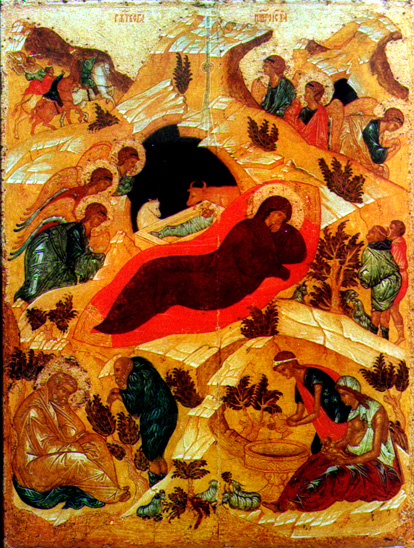
This is a repost from my mySpace blog. I only use the mySpace blog to either point people here or to chat with a few friends who seem to like the mySpace world. But I thought it might be enjoyed here, even start up a little discussion about Mary. So enjoy. (As a point of interest the icon on the right is a traditional Eastern icon for Christmas. Note the baby Jesus in a cave reflective of this burial tomb (even the swaddling cloths suggest this) and the old guy talking to Joseph (bottom left) is the Devil.)
=============
I recently posted on the Freedom Log about tackling Mariology in an exam. I've been studying (mostly part-time) at a Catholic University for six years now and this is the first year I've really encountered a nuanced teaching on Marian thought and doctrine. I encountered it in an Eastern Studies course with John Jillions and in a Catholic Ecclesiology course with Catherine Clifford. I really enjoyed wrestling with this topic a bit simply because it is not something that really comes up in any of the traditions I have been part of, at least not in a healthy way.
On the Roman Catholic side the focus was Vatican II and beyond. So in the Dogmatic Constitution on the Church (Lumen Gentium) there is a whole chapter on Mary. This document really outlines the importance and structure of Mary's relationship to the Church. But to outline that I should try and crack a few chestnuts with regard to popular protestant thought about Mariology. First the whole idea of saint worship is troubling to all Christians. Anyone faithful to the Catholic teaching would make a clear distinction between veneration and worship. God alone is to be worshipped. The lives of saints are celebrated as both Christian encouragement and as interceders in the Great Cloud of Witness. Second the idea that Mary's role in any way overshadows or replaces Christ's role is also troubling to all Christians. Lumen Gentium (LG) makes this very clear (LG.62).
In the proper Catholic teaching on Mary the Theotokos (God bearer), like all good teaching on Mary is more concerned with what we are saying about Christ and the Incarnation of Christ than about Mary herself. So, for instance, the virgin birth is an important dogma because it expresses our conviction that Jesus was born with both human and Divine natures. He is not a mere human who attains deification, but rather God who humbles himself to take on humanity. In the East there is really only one absolutely necessary dogma on Mary, that she is the Theotokos or the one who bears God. Like Catholocism there are a number of additional interesting Marian streams of thought, but these are more a matter of local devotional practices.
Back to the Catholics. What is cool is that many were pushing (in the 70's IIRC) for Mary to be officially given the title Co-Redemtrix. A confusing term that is meant to capture Mary's necessary role in redemption, meaning her obedience to God. This title was dropped because it could easily be confused with Mary being elevated to the position of Christ. Indeed some theologians have even extrapolated that Mary was the the third person of the Trinity usurping the role of the Holy Spirit (Boff). These are pretty dangerous claims and do not sit well with the mainstream of Catholic Marian teaching.
There are some aspects of Marian thought in LG that are disturbing. Hurdles that I think we should address. LG. 54 says that Mary occupies the highest place in the Church after Christ and that she is closest to us. When she is absent from our ecclesial langauge she is really not that close to us. Also this is based on a heirarchical vision of Church which is being challenged more and more. Mary does deserve a special place in our hearts and church life, but this is taking it a bit far.
LG. 56 talks of Mary as the predestined mother. This is based on flawed fall theology. And it refuses to admit that Mary had any choice in the matter. If she had no choice then her role as an example of faithful obedience is diminished. Also there is some crazy notion of Eve's virginity, Catholics seem to really value virginity in an almost supernatural way. But we'll talk about why in the next problem area.
LG. 57 tells us that, apparently, Jesus' birth consecrated Mary's virginity. This is anatomically impossible to begin with, but what is most interesting is that it is part of the lingering Catholic hangup with all things reproductive. Sex is seen as sinful and so for Mary to continue to be holy there is a myth of her perpetual virginity that is carried on in Catholic tradition. I say myth because some Catholics live or die on this one. But I think there is value in the myth if it says something about Christ (which I bet it does for many Catholics) but for me it is unneccessary. Mostly because it is based on flawed notions of human sexuality and original sin. But more because the important issue is captured already in the dogma of Christ's immaculate conception, this does not need to be carried over to Mary (sorry Pious XI).
I like that the discourse on Mary is placed in the context of the Church. This shows that Mary is also a member of the Church. As a Christian from non-Marian and anti-Marian roots this gives me a framework for understanding why she is venerated as she is. Indeed I've seen similar devotion to living and dead pastors in the movements I come from. And yes sometimes it gets out of hand. But most of it is meant to be encouraging. Is that not the real role of Mary? To encourage us to radical obedience. For myself there is room in my spirituality for encouragement. You won't find me incorporating a Rosary into my devotional practice but I do think I will find space to bring thoughts of Mary into my ownmeditation, especially in this season of Advent.
Love to hear your thoughts and experiences.
Friday, November 24, 2006
[THO] The Divine Liturgy of Does This Ever End?

This was painful to get through. But it did give me a sense of what actually is going on. It is pretty hard to figure that out from words on a page. I was assuming a whole lot more of this was accessible to the people, boy was I wrong. I am not sure why it is so maddening to see a priest calling the occasional phrase over his shoulder at the people, but it is. I think what is more frustrating is that after watching this and pouring over the text I just don't get the sense of what Schmemann sees. It is going to be a long night.
Tuesday, October 10, 2006
[THO] Worship VIII
Worship Pedigree
OK I freely admit it – I am a worshipaholic! I can't get enough of it. I love high liturgy, low liturgy, what is mistakenly called no liturgy, I like almost all of it. There are only three types of worship that don't get me going, low participation worship (special songs, choirs, etc.), thematic worship (usually when everything is meant to serve the teaching) and forced participation worship (hype worship). Other than that I am most comfortable in the midst of worship with my hands held up and my voice raised in song. I love it.
The last message we looked at why we worship. As a worship leader it is important to understand what happens when worship is good. But some of that understanding comes from our own experiences of worship, what I call the worship pedigree. Each of us has one, so in exploring my own I’m hoping to point out a few key lessons, a few highlights and even a few letdowns. So here is my story of worship.
Early Worship Experiences
I became a Christian in the midst of a Pentecostal youth rally. The music was loud and all about surrender. My conversion was a clash of cultures and an encounter with the powerful presence of God. I could not deny it; I could only get on my face before the God I encountered. I came out of a place where I thought I knew something; I was into a lot of spiritual things and felt like I could take on anything. But when I encountered the love of God it completely disarmed me. It was so profound that I would often lose myself in worship, as it seemed to me the only adequate respond to this love.
Worship Pastor
I left my hometown and eventually landed in Ottawa working with a street church. We had a wonderful worship leader named Angela Justa, and we would worship in song for at least an hour at a time in service (usually twice a service). We often met throughout the weeks in our apartments and homes to worship and prepare for street evangelism. In those days I picked up some basic guitar and loved the freedom of being able to worship on my own. Then I was transferred to Mississauga to be the youth and worship pastor for a Foursquare church plant. Those simple Pentecostal songs (and a few Vineyard tunes I picked up along the way) flowed out of me as I learned the art of congregational worship leading. Those were good days, but they were not to last long.
Weight of the World
Soon my world came crashing down on me. Frankly I was released into ministry too early in my Christian walk. I came to the church plant with a strong sense of personal agenda and add to that a growing discomfort with the Pentecostal philosophy of ministry. Needless to say that ministry experience ended badly for me, I was removed from ministry and left wondering what had happened. But in the midst of that time of trial, God drew near. To be honest I was really screwed up. I struggled a lot with old habits, but still God kept coming near. I often would turn to God in worship, just my guitar and I. For me it was then that I learned how to pour out my whole being in worship. I learned how to flee to God when nothing else in life made any sense.
The Vineyard
I discovered the Vineyard not long after that; well it is more complicated than that. I knew of the Vineyard and was convinced it was a cult. So when in the midst of my crash trusted friends kept recommending a Vineyard kingship, I was sceptical to say the least. Not far from the basement I rented there met a little kinship, part of the famous Airport church (pre-Toronto Blessing days). It was the first time corporate worship named my pain and let me sing a real song to God. Despite my misgivings those folks embraced me and began restoring me to health. It helped that I also discovered Kevin Prosch in those days, another refuge in the storm. No matter what else was going wrong in my life I always had worship to come back to. And the thing about the Vineyard, there people who led worship really had something precious. It wasn't about hyping up the crowd nor was it about trying to make something happen. It was worship because that is just what we do; worship for the sake of worship. It happened to be artsy, but not overly complicated. It was emotive but not manipulative. It was honest.
Back to Ottawa
Though my experience of the Vineyard was profound, it was also short lived. I found an excuse to get away from Mississauga, my friends Andy and Angela were planting again in Ottawa so I came back. I did lead worship for them for a very short while, but I was far too broken to really jump back into a ministry role. I started busking and doing handyman work for the Yellow Lady (long story) to pay the bills, I lived pretty frugally in those days. I connected with Ottawa Youth Alive, a praise and worship ministry in the city and ended up at a Baptist church. That Baptist church was a wonderful place for me. I ended up going back to school, completed my high school and started college. I also began doing a lot more worship stuff, in fact I was one of the guitarists for the big national Convention Baptist gathering here in Ottawa, I forget what year but we had Campolo speaking to the youth. Towards the end of my time there I served as a lay minister and recorded a demo tape of my own songs - Frank in Session. Personally I learned a lot about just worshipping. What I loved about Pentecostal spirituality was that space they made for God to show up in powerful ways, especially in their prayer meetings. The only thing that got close to that outside of the Pentecostal movements was worship in song. At least, that is, until I discovered sacramental worship.
Not long after this I met my wife Sharon. We left the Baptist church for complicated reasons (not bad, just complicated) and hooked up with the Vineyard that was just starting up in Ottawa. That was quite amazing and this was when the Toronto Blessing renewal was in full swing, probably the worst thing to happen to the Ottawa Vineyard. We went there in the midst of all this chaos and eventually some immature people pissed my wife off to the point she wanted nothing to do with the Vineyard ever again. I was crushed. I loved the Vineyard, heck I was having a lot of fun with the renewal stuff too as desperately I needed to reconnect with my charismatic side. But Sharon had a better vantage than I that the way this church was a lot of people were going to get hurt. So much as it pained me we left and went to a wonderful local Wesleyan church, we also got married around that time.
I'm going to skip a bit here; basically those years were more about maturing in our relationship than in our worship. But we did lead a listening group at Sunnyside Wesleyan that was really quite cool. But those days were more of holding the ground liturgically.
Coming Home
God brought us back to the Vineyard about three years after we had left. Unfortunately the church, which had sprung up quickly in the renewal, never really established a strong foundation. Too many people who had come out were more interested in their spiritual fix than in really seeing a church planted, at least not the church that the pastoral couple had come to plant. Our friends who pastored that church were simply spent. We came in and asked them to train us up to plant a Vineyard. A few years later we planted Freedom and this is where God began stretching me in worship again.
Training
With a new plant we needed worship leaders. We had a good core of leaders who were passionate about worship. Our policy was we'd let anyone do anything as long as they were ready to have feedback (it still is BTW). Those were great days and I learned a lot. That is where I really fell in love with the Vineyard three crescendo liturgy. But there was another stretch to come.
I also began studying at St. Paul University, a pontifical university. And there I began to understand more of what it meant to worship as a church. The more that I saw the sacramental side of worship; the more convinced I was that we evangelicals were missing something precious. Through a course in Celtic Christian Spirituality I became aware of the power of imagination. Through a course in liturgy I began to hunger for the way that sacraments fed the imagination. I was hooked and started to do little experiments with our congregation. Little things at first, but it grew. And other people were getting excited too. It was like finding a gem that had been lost on the path years ago; we fell in love with our emerging Eucharistic side.
Why I Love Worship
There is something so profound about worship. Worship makes a space for the encounter of God. For me I love to worship, I was just with my new friend Dan in the amphitheatre at school - two guitars, two voices and a whole lot of lost in worship. For me it is life imparting. Whether it is a song or prayer, the psalms or an act. Something about worship reorients my heart and opens my eyes to God's presence. It makes moments sacred. And that is why I am a worshipaholic.
The way I feel about worship, there is no real final destiny, just worship that gets better and better. I am convinced that those who long for worship will be led into the resources for worship. Sometimes from surprising places too. My story of worship is far from complete.
Next I want to finish up with a reflection on the theology of worship.
OK I freely admit it – I am a worshipaholic! I can't get enough of it. I love high liturgy, low liturgy, what is mistakenly called no liturgy, I like almost all of it. There are only three types of worship that don't get me going, low participation worship (special songs, choirs, etc.), thematic worship (usually when everything is meant to serve the teaching) and forced participation worship (hype worship). Other than that I am most comfortable in the midst of worship with my hands held up and my voice raised in song. I love it.
The last message we looked at why we worship. As a worship leader it is important to understand what happens when worship is good. But some of that understanding comes from our own experiences of worship, what I call the worship pedigree. Each of us has one, so in exploring my own I’m hoping to point out a few key lessons, a few highlights and even a few letdowns. So here is my story of worship.
Early Worship Experiences
I became a Christian in the midst of a Pentecostal youth rally. The music was loud and all about surrender. My conversion was a clash of cultures and an encounter with the powerful presence of God. I could not deny it; I could only get on my face before the God I encountered. I came out of a place where I thought I knew something; I was into a lot of spiritual things and felt like I could take on anything. But when I encountered the love of God it completely disarmed me. It was so profound that I would often lose myself in worship, as it seemed to me the only adequate respond to this love.
Worship Pastor
I left my hometown and eventually landed in Ottawa working with a street church. We had a wonderful worship leader named Angela Justa, and we would worship in song for at least an hour at a time in service (usually twice a service). We often met throughout the weeks in our apartments and homes to worship and prepare for street evangelism. In those days I picked up some basic guitar and loved the freedom of being able to worship on my own. Then I was transferred to Mississauga to be the youth and worship pastor for a Foursquare church plant. Those simple Pentecostal songs (and a few Vineyard tunes I picked up along the way) flowed out of me as I learned the art of congregational worship leading. Those were good days, but they were not to last long.
Weight of the World
Soon my world came crashing down on me. Frankly I was released into ministry too early in my Christian walk. I came to the church plant with a strong sense of personal agenda and add to that a growing discomfort with the Pentecostal philosophy of ministry. Needless to say that ministry experience ended badly for me, I was removed from ministry and left wondering what had happened. But in the midst of that time of trial, God drew near. To be honest I was really screwed up. I struggled a lot with old habits, but still God kept coming near. I often would turn to God in worship, just my guitar and I. For me it was then that I learned how to pour out my whole being in worship. I learned how to flee to God when nothing else in life made any sense.
The Vineyard
I discovered the Vineyard not long after that; well it is more complicated than that. I knew of the Vineyard and was convinced it was a cult. So when in the midst of my crash trusted friends kept recommending a Vineyard kingship, I was sceptical to say the least. Not far from the basement I rented there met a little kinship, part of the famous Airport church (pre-Toronto Blessing days). It was the first time corporate worship named my pain and let me sing a real song to God. Despite my misgivings those folks embraced me and began restoring me to health. It helped that I also discovered Kevin Prosch in those days, another refuge in the storm. No matter what else was going wrong in my life I always had worship to come back to. And the thing about the Vineyard, there people who led worship really had something precious. It wasn't about hyping up the crowd nor was it about trying to make something happen. It was worship because that is just what we do; worship for the sake of worship. It happened to be artsy, but not overly complicated. It was emotive but not manipulative. It was honest.
Back to Ottawa
Though my experience of the Vineyard was profound, it was also short lived. I found an excuse to get away from Mississauga, my friends Andy and Angela were planting again in Ottawa so I came back. I did lead worship for them for a very short while, but I was far too broken to really jump back into a ministry role. I started busking and doing handyman work for the Yellow Lady (long story) to pay the bills, I lived pretty frugally in those days. I connected with Ottawa Youth Alive, a praise and worship ministry in the city and ended up at a Baptist church. That Baptist church was a wonderful place for me. I ended up going back to school, completed my high school and started college. I also began doing a lot more worship stuff, in fact I was one of the guitarists for the big national Convention Baptist gathering here in Ottawa, I forget what year but we had Campolo speaking to the youth. Towards the end of my time there I served as a lay minister and recorded a demo tape of my own songs - Frank in Session. Personally I learned a lot about just worshipping. What I loved about Pentecostal spirituality was that space they made for God to show up in powerful ways, especially in their prayer meetings. The only thing that got close to that outside of the Pentecostal movements was worship in song. At least, that is, until I discovered sacramental worship.
Not long after this I met my wife Sharon. We left the Baptist church for complicated reasons (not bad, just complicated) and hooked up with the Vineyard that was just starting up in Ottawa. That was quite amazing and this was when the Toronto Blessing renewal was in full swing, probably the worst thing to happen to the Ottawa Vineyard. We went there in the midst of all this chaos and eventually some immature people pissed my wife off to the point she wanted nothing to do with the Vineyard ever again. I was crushed. I loved the Vineyard, heck I was having a lot of fun with the renewal stuff too as desperately I needed to reconnect with my charismatic side. But Sharon had a better vantage than I that the way this church was a lot of people were going to get hurt. So much as it pained me we left and went to a wonderful local Wesleyan church, we also got married around that time.
I'm going to skip a bit here; basically those years were more about maturing in our relationship than in our worship. But we did lead a listening group at Sunnyside Wesleyan that was really quite cool. But those days were more of holding the ground liturgically.
Coming Home
God brought us back to the Vineyard about three years after we had left. Unfortunately the church, which had sprung up quickly in the renewal, never really established a strong foundation. Too many people who had come out were more interested in their spiritual fix than in really seeing a church planted, at least not the church that the pastoral couple had come to plant. Our friends who pastored that church were simply spent. We came in and asked them to train us up to plant a Vineyard. A few years later we planted Freedom and this is where God began stretching me in worship again.
Training
With a new plant we needed worship leaders. We had a good core of leaders who were passionate about worship. Our policy was we'd let anyone do anything as long as they were ready to have feedback (it still is BTW). Those were great days and I learned a lot. That is where I really fell in love with the Vineyard three crescendo liturgy. But there was another stretch to come.
I also began studying at St. Paul University, a pontifical university. And there I began to understand more of what it meant to worship as a church. The more that I saw the sacramental side of worship; the more convinced I was that we evangelicals were missing something precious. Through a course in Celtic Christian Spirituality I became aware of the power of imagination. Through a course in liturgy I began to hunger for the way that sacraments fed the imagination. I was hooked and started to do little experiments with our congregation. Little things at first, but it grew. And other people were getting excited too. It was like finding a gem that had been lost on the path years ago; we fell in love with our emerging Eucharistic side.
Why I Love Worship
There is something so profound about worship. Worship makes a space for the encounter of God. For me I love to worship, I was just with my new friend Dan in the amphitheatre at school - two guitars, two voices and a whole lot of lost in worship. For me it is life imparting. Whether it is a song or prayer, the psalms or an act. Something about worship reorients my heart and opens my eyes to God's presence. It makes moments sacred. And that is why I am a worshipaholic.
The way I feel about worship, there is no real final destiny, just worship that gets better and better. I am convinced that those who long for worship will be led into the resources for worship. Sometimes from surprising places too. My story of worship is far from complete.
Next I want to finish up with a reflection on the theology of worship.
Friday, October 06, 2006
[THO] Worship VII
Why do we worship?
The obvious place to start with this question, at least for me, is that we worship in response to God’s revealed goodness. Because God is worthy to be worshipped – we worship. That might be a great place to start theologically, but my intention in this post is more to give a sense of how worship functions within a congregational setting. These are important to understand if we are concerned with improving the quality of our congregational worship.
I would like to break this down into psychological, sociological and spiritual effects, but as we will soon see that is a bit tangled up. It is hard to separate the psychological benefits from the spiritual and the sociological benefits; the psychological benefits seem to fall directly out of these other categories. So we’ll explore the benefits of worship from the psychological vantage and identify how each benefit is also sociological and/or spiritual. Just to make this clear, psychological benefits are those that affect the person, hopefully in a positive way. The sociological benefits are those that affect the dynamics of the group or congregation. And the spiritual benefits belong to the category of transcendence, in other words they affect the participants faith. One might add that a worship session can be an effective cardio programme, but that really depends on the degree of physical movement within the liturgy. I am not convinced that movement is a prerequisite to good worship, even though I do admit I love to dance in worship (at the back and not wearing tights).
Untangling the Benefits
When we talk about what worship does for the participant, it orients them towards a horizon of hope (spiritual and sociological). It makes us aware that God can and does step into our lives. It reminds us that God is intimately involved with every aspect of our existence, and that alone is enough to give us hope. Another way of seeing this is that worship makes space for encounter with the divine. This is why we see spontaneous healings happen in the midst of the singing. It is also why sometimes folks are overcome by the presence of God. Why in the midst of the sacramental acts people find profound meaning. Those are all great things when they happen, but they are not our focus or reason for worshipping. But they are definitely a benefit to both the worshipper and the congregation.
Worship lets us feel like we belong (sociological). Good worship, I should hasten to add. Some worship is exclusive in nature when it should be invitational. God is revealed as the one who opened his arms to the world, for us to turn around and close those arms does an injustice to the revelation of the Christian God. So when we worship in the community, we identify that community as our own. It also joins us to the whole Church that worships God, because this is what we all do.
Worship also models unity in a healthy way (sociological). In a good worship setting there is a variety of responses to God. A common liturgy unites us, but our responses are our own. Some lift their hands, some sing boldly, some meditate in quietness, some dance, some cry, some laugh, some kneel, some prostrate themselves, some contemplate, some pray, some vocalize, some... well you get the picture. Healthy worship invites the congregants to respond to God individually and corporately. It is quite amazing when this is functioning well. There is a sense of freedom and safety that envelops you when you worship in a healthy environment. There is an invitation to let down your guard and be yourself. That is a gift, one we should always foster. For the sceptics I want to hasten that I’ve experienced this in a high Anglican liturgy and I’ve felt the lack of it in a lively Pentecostal liturgy. This needs to be fostered, it should never be assumed.
Worship also orders our priorities (spiritual and sociological). Life can get pretty complicated and we can easily lose sight of a healthy rhythm of living. Worship presents a framework of priorities that we can find deep comfort in. That order is God, community and self. When we put God first we are really acknowledging our dependence on God. This is so important when all our cultural myths revolve around the individual. It is no wonder we see so much frustration in the Western world, we live well beyond our means (and I am not just referring to how we live financially). But worship turns our focus on God who meets us in our place of need. Secondly worship places us into the context of the community. We worship together not to make a bigger noise, but because we are in this together. We are joined together as family and learn in worship how to live as that family. We not only need God, but we need each other. So in worship we serve each other sacramentally as a sign of our life together as a sacrament of the Kingdom. And finally worship doesn’t lose the importance of self; it just places self in the proper perspective. Worship is nothing without the worshipper.
Worship informs our mission as a Church (sociological and spiritual). The liturgy makes it clear that we are not a bless-me club. The liturgy orients us towards the world; it gives us the resources to be Christ’s body in the world. Some people think it just gives us resources to get through life, but this is part of the operative evangelical myth (something I am going to blog on soon). This myth takes Jesus’ gospel formulation “The Kingdom of God has come” and twists it into “Where are you going to spend eternity?” That is worth unpacking because it has been quite destructive historically. Worship is not giving you a fuel up so you can make it to the next worship session. No worship is a picture of God stepping into the world that empowers our own lives for living. Worship gives us life so that we can be life in the world. We gain peace so we can bring peace. We a filled with love so we can love. We are comforted so that we can comfort others. We are empowered so we can bring a powerful message of word and deed to others. We are healed so we can heal others. We are given hope so we can give hope to others. This is our mission. Good worship doesn’t lose sight of this.
I am sure there are other benefits to worship. I think there is enough here to chew on for a while. Next I’m going to share my history of worship, some of the highlights of my life as a worshipping Christian. I actually wrote that one already, but I want to tweak it still. As always I look forward to your comments.
The obvious place to start with this question, at least for me, is that we worship in response to God’s revealed goodness. Because God is worthy to be worshipped – we worship. That might be a great place to start theologically, but my intention in this post is more to give a sense of how worship functions within a congregational setting. These are important to understand if we are concerned with improving the quality of our congregational worship.
I would like to break this down into psychological, sociological and spiritual effects, but as we will soon see that is a bit tangled up. It is hard to separate the psychological benefits from the spiritual and the sociological benefits; the psychological benefits seem to fall directly out of these other categories. So we’ll explore the benefits of worship from the psychological vantage and identify how each benefit is also sociological and/or spiritual. Just to make this clear, psychological benefits are those that affect the person, hopefully in a positive way. The sociological benefits are those that affect the dynamics of the group or congregation. And the spiritual benefits belong to the category of transcendence, in other words they affect the participants faith. One might add that a worship session can be an effective cardio programme, but that really depends on the degree of physical movement within the liturgy. I am not convinced that movement is a prerequisite to good worship, even though I do admit I love to dance in worship (at the back and not wearing tights).
Untangling the Benefits
When we talk about what worship does for the participant, it orients them towards a horizon of hope (spiritual and sociological). It makes us aware that God can and does step into our lives. It reminds us that God is intimately involved with every aspect of our existence, and that alone is enough to give us hope. Another way of seeing this is that worship makes space for encounter with the divine. This is why we see spontaneous healings happen in the midst of the singing. It is also why sometimes folks are overcome by the presence of God. Why in the midst of the sacramental acts people find profound meaning. Those are all great things when they happen, but they are not our focus or reason for worshipping. But they are definitely a benefit to both the worshipper and the congregation.
Worship lets us feel like we belong (sociological). Good worship, I should hasten to add. Some worship is exclusive in nature when it should be invitational. God is revealed as the one who opened his arms to the world, for us to turn around and close those arms does an injustice to the revelation of the Christian God. So when we worship in the community, we identify that community as our own. It also joins us to the whole Church that worships God, because this is what we all do.
Worship also models unity in a healthy way (sociological). In a good worship setting there is a variety of responses to God. A common liturgy unites us, but our responses are our own. Some lift their hands, some sing boldly, some meditate in quietness, some dance, some cry, some laugh, some kneel, some prostrate themselves, some contemplate, some pray, some vocalize, some... well you get the picture. Healthy worship invites the congregants to respond to God individually and corporately. It is quite amazing when this is functioning well. There is a sense of freedom and safety that envelops you when you worship in a healthy environment. There is an invitation to let down your guard and be yourself. That is a gift, one we should always foster. For the sceptics I want to hasten that I’ve experienced this in a high Anglican liturgy and I’ve felt the lack of it in a lively Pentecostal liturgy. This needs to be fostered, it should never be assumed.
Worship also orders our priorities (spiritual and sociological). Life can get pretty complicated and we can easily lose sight of a healthy rhythm of living. Worship presents a framework of priorities that we can find deep comfort in. That order is God, community and self. When we put God first we are really acknowledging our dependence on God. This is so important when all our cultural myths revolve around the individual. It is no wonder we see so much frustration in the Western world, we live well beyond our means (and I am not just referring to how we live financially). But worship turns our focus on God who meets us in our place of need. Secondly worship places us into the context of the community. We worship together not to make a bigger noise, but because we are in this together. We are joined together as family and learn in worship how to live as that family. We not only need God, but we need each other. So in worship we serve each other sacramentally as a sign of our life together as a sacrament of the Kingdom. And finally worship doesn’t lose the importance of self; it just places self in the proper perspective. Worship is nothing without the worshipper.
Worship informs our mission as a Church (sociological and spiritual). The liturgy makes it clear that we are not a bless-me club. The liturgy orients us towards the world; it gives us the resources to be Christ’s body in the world. Some people think it just gives us resources to get through life, but this is part of the operative evangelical myth (something I am going to blog on soon). This myth takes Jesus’ gospel formulation “The Kingdom of God has come” and twists it into “Where are you going to spend eternity?” That is worth unpacking because it has been quite destructive historically. Worship is not giving you a fuel up so you can make it to the next worship session. No worship is a picture of God stepping into the world that empowers our own lives for living. Worship gives us life so that we can be life in the world. We gain peace so we can bring peace. We a filled with love so we can love. We are comforted so that we can comfort others. We are empowered so we can bring a powerful message of word and deed to others. We are healed so we can heal others. We are given hope so we can give hope to others. This is our mission. Good worship doesn’t lose sight of this.
I am sure there are other benefits to worship. I think there is enough here to chew on for a while. Next I’m going to share my history of worship, some of the highlights of my life as a worshipping Christian. I actually wrote that one already, but I want to tweak it still. As always I look forward to your comments.
Friday, September 22, 2006
[THO] Worship VI
It is important to understand the parts of worship as well as how these various parts interact with each other. If we understand what is going on in the part of the liturgy (service) then we can better know where we can improve the liturgy.
Liturgy
The whole of the service is called a liturgy. The liturgy literally means the work of the people. It is interesting that a secular term was employed by the early church to define what it was they did when they came together to corporately worship God. We sometimes think of work as a bad thing, or at least an exhausting activity. But work in this sense indicates that it is something we all come and participate in. It is something we do together as a community. And it is something that accomplishes. The liturgy then is not meant to be a task we come and experience once a week. But it is something we come together to be a part of doing that builds us as the people of God. Worship must have goals.
This might seem odd to some of us, we love worship and the idea of worship as being utilitarian seems just a bit perverse. I think we need to hold the creative tension of worship, but it does do something. In fact if we can't see worship as being intentionally oriented towards accomplishing certain goals then we will not know how to judge if our worship is growing more worshipful. These are not arbitrary goals, they have to do with the whole idea of liturgy.
Work of the People
Worship creates a people. Worship has the goal of creating community. It points a gathered body of people in the same direction. It shapes the community as one that comes together before God to be God's Church (ecclesia). Far from a mundane task, worship is about togetherness. When worship becomes all about the self it loses much of its creative potential. There are many moments in worship that are intensely personal, but it is the shared aspect of these deeply personal experiences that makes us the people of God's presence. This is why we have people share their experiences in worship. There is much about the liturgy that is oriented specifically towards building this common shared experience.
But what is this work? It is the worship of God. Worship must also have a goal of actually worshipping our God. This is done through a variety of ways. We could spend a whole series just on what is worship. Worship is presenting ourselves to God. Worship is glorifying God. Worship is telling God's story faithfully. Worship is giving our time, energy and money. Worship is loving God. Worship is encounter with God. Worship is singing praise. Worship is resting in God's presence. Worship is all these things and more. Different communities will emphasize different aspects of worship, and they should. There are few wrong ways to worship God who is worthy of all worship and praise. The goal here is not to cover all the bases, but to know that at the end of the liturgy God was worshipped.
I think the temptation is to make it more complicated than that. Surely there must be more goals then I've listed. Really I've only given you two goals: that it brings us together and that God is worshipped. We might want to add a goal of our own transformation, perhaps. But when we do we begin to shape what God wants to do with us as a people, and this is dangerous territory. Our prayer, as a people, is always "Your will be done."
Three Crescendo
The typical Vineyard service is not unlike other evangelical churches. We have what is known as a three crescendo service. Each crescendo, for us, is important and not subserviant to any other. Each crescendo is important in and of itself. There are a lot of liturgical forms, in fact we use quite a different form when we celebrate the Eucharist. But there is something profoundly powerful and the typical Vineyard liturgy.
Worship in Song
We begin with worship in song. For us that is all about singing. We sing intimate songs to God and sometimes lovely songs about God. There is often some interaction between those leading and those participating, but it is all about the singing in this section of the liturgy. There is something about this time that gathers us together and transports us before the very throne of God. And for this liturgical structure worship isn't about the teaching or the giving or anything else, it is simply a time for us to corporately express our love to God.
Teaching of the Word
The second cresendo for us usually occurs after a break. There are technical elements such as prayers, offerings, etc. that occur around this time, but those are often treated in a very peripheral way. The crescendo here is a message that is most often an exposition of scripture. My community is lectional, but that is not the case for the majority of Vineyards I've been to. But there is a strong value of the bible as our foundational text. This section of the liturgy orientes us towards common values and often draws us into a common story.
Ministry of Prayer
The final crescendo in a Vineyard service is a time of prayer. This is important to us as a community. It isn't like an evangelical altar call, often it has nothing to do with the actual teaching. But it is a time for us as a people to gather around each other and be the body of Christ. Of all the things we do in our services it is this crescendo that has touched people the deepest.
The Flow
Even though there is a seperation of these crescendos, there is also a flow that goes through them. We begin together, open before God and asking for God's visitation. From there we listen to God's word, letting it orient our hearts towards God's own heart. Finally we put this into practice, being the people of God who are so moved by His love for us that we reach out in love for each other. Like any good liturgy each part flows into the other so that we accomplish the goals of worship: being God's gathered people and worshipping God.
We could analyse other liturgical structures in a similar way. Knowing how each part functions helps us to understand how well these parts are functioning both independantly and corporately. Understanding that there is a flow that moves through our service of worship helps us to see if the parts are functioning as a whole. Understanding all this we can continue to develop our worship so that it gets better and better.
Next Worshipaholic!
Liturgy
The whole of the service is called a liturgy. The liturgy literally means the work of the people. It is interesting that a secular term was employed by the early church to define what it was they did when they came together to corporately worship God. We sometimes think of work as a bad thing, or at least an exhausting activity. But work in this sense indicates that it is something we all come and participate in. It is something we do together as a community. And it is something that accomplishes. The liturgy then is not meant to be a task we come and experience once a week. But it is something we come together to be a part of doing that builds us as the people of God. Worship must have goals.
This might seem odd to some of us, we love worship and the idea of worship as being utilitarian seems just a bit perverse. I think we need to hold the creative tension of worship, but it does do something. In fact if we can't see worship as being intentionally oriented towards accomplishing certain goals then we will not know how to judge if our worship is growing more worshipful. These are not arbitrary goals, they have to do with the whole idea of liturgy.
Work of the People
Worship creates a people. Worship has the goal of creating community. It points a gathered body of people in the same direction. It shapes the community as one that comes together before God to be God's Church (ecclesia). Far from a mundane task, worship is about togetherness. When worship becomes all about the self it loses much of its creative potential. There are many moments in worship that are intensely personal, but it is the shared aspect of these deeply personal experiences that makes us the people of God's presence. This is why we have people share their experiences in worship. There is much about the liturgy that is oriented specifically towards building this common shared experience.
But what is this work? It is the worship of God. Worship must also have a goal of actually worshipping our God. This is done through a variety of ways. We could spend a whole series just on what is worship. Worship is presenting ourselves to God. Worship is glorifying God. Worship is telling God's story faithfully. Worship is giving our time, energy and money. Worship is loving God. Worship is encounter with God. Worship is singing praise. Worship is resting in God's presence. Worship is all these things and more. Different communities will emphasize different aspects of worship, and they should. There are few wrong ways to worship God who is worthy of all worship and praise. The goal here is not to cover all the bases, but to know that at the end of the liturgy God was worshipped.
I think the temptation is to make it more complicated than that. Surely there must be more goals then I've listed. Really I've only given you two goals: that it brings us together and that God is worshipped. We might want to add a goal of our own transformation, perhaps. But when we do we begin to shape what God wants to do with us as a people, and this is dangerous territory. Our prayer, as a people, is always "Your will be done."
Three Crescendo
The typical Vineyard service is not unlike other evangelical churches. We have what is known as a three crescendo service. Each crescendo, for us, is important and not subserviant to any other. Each crescendo is important in and of itself. There are a lot of liturgical forms, in fact we use quite a different form when we celebrate the Eucharist. But there is something profoundly powerful and the typical Vineyard liturgy.
Worship in Song
We begin with worship in song. For us that is all about singing. We sing intimate songs to God and sometimes lovely songs about God. There is often some interaction between those leading and those participating, but it is all about the singing in this section of the liturgy. There is something about this time that gathers us together and transports us before the very throne of God. And for this liturgical structure worship isn't about the teaching or the giving or anything else, it is simply a time for us to corporately express our love to God.
Teaching of the Word
The second cresendo for us usually occurs after a break. There are technical elements such as prayers, offerings, etc. that occur around this time, but those are often treated in a very peripheral way. The crescendo here is a message that is most often an exposition of scripture. My community is lectional, but that is not the case for the majority of Vineyards I've been to. But there is a strong value of the bible as our foundational text. This section of the liturgy orientes us towards common values and often draws us into a common story.
Ministry of Prayer
The final crescendo in a Vineyard service is a time of prayer. This is important to us as a community. It isn't like an evangelical altar call, often it has nothing to do with the actual teaching. But it is a time for us as a people to gather around each other and be the body of Christ. Of all the things we do in our services it is this crescendo that has touched people the deepest.
The Flow
Even though there is a seperation of these crescendos, there is also a flow that goes through them. We begin together, open before God and asking for God's visitation. From there we listen to God's word, letting it orient our hearts towards God's own heart. Finally we put this into practice, being the people of God who are so moved by His love for us that we reach out in love for each other. Like any good liturgy each part flows into the other so that we accomplish the goals of worship: being God's gathered people and worshipping God.
We could analyse other liturgical structures in a similar way. Knowing how each part functions helps us to understand how well these parts are functioning both independantly and corporately. Understanding that there is a flow that moves through our service of worship helps us to see if the parts are functioning as a whole. Understanding all this we can continue to develop our worship so that it gets better and better.
Next Worshipaholic!
Subscribe to:
Posts (Atom)