There were iterations of this statement that I completely adored. But again what is with all the granularity. Ok I need to dig into this one a bit. Let me say though that the restoration of both Word and Table is a much needed reformation in the Evangelical church. It isn't about doing one or the other well, but bringing them together to tell God's story that becomes our story.
But I find my frustration in one little sentence: "We call for a renewed consideration of how God ministers to us in baptism, eucharist, confession, the laying on of hands, marriage, healing and through the charisms of the Spirit, for these actions shape our lives and signify the meaning of the world."
Seems all well and good, but what does it really add? It doesn't invite those traditions that have no understanding of the terms eucharist, confession, laying on of hands, charisms of the Spirit. In fact I can think of many different groups that would be turned off by this statement. And on a personal note, why did they include marriage? Maybe to give some hope to the fundies who are already freaked about the references to eucharist and confession?
Take this sentence out and you are starting to really have something. The opening line is a zinger that grabs the attention. The third sentence is a bit heady, but forgivably so it doesn't throw you off like sentence two does. The next is meant to jar everyone, but in a good way. It might not be necessary, but it doesn't hurt. But the last sentence does it all for me - here we are calling the Evangelical church to grapple with historic Christian worship, beautiful. And it is the substance that we are calling for, not just the accidents, even more beautiful. This is what I've been about for the last four years as we've discovered just how rich tapping into these deep waters can be. I don't have any illusions that we look like the ancient Church, but we do share some substance with that Church which has made all the difference.
Saturday, September 02, 2006


[THO] The Call: Theological Reflection
This is where Trinity belongs, but instead we are given what I think is an overly ambitious statement. It is in no way clear what we are called to as "the tradition that has been believed everywhere, always and by all". The appeal to the early Church Fathers is a bit romantic for reality, anyone who has tried to find concensus in the Patristics should know this. Part of the appeal is that in its earliest forms Christianity was a wrestling theology, one wrestled with theology as the theology wrestled with you. There is a dynamic relationship that defies being reduced to a lowest common denominator.
Also I am uncomfortable with the unqualified attack on modern theology. I suppose, if I had to guess, that this statement would like to see the creedal faith a serious part of theological reflection. Also I kind of get the sense that they would like to bridge the gulf between acadamia and litugia, great but they don't say that directly and I could be reading my own heart into the statement. Perhaps the problem, once again, is that we have tried to overcomplicate this section of the call and not brought forward a single clear thought that the reader can latch onto and run with.
These statements do get better, one of the best ones is coming up next.
Also I am uncomfortable with the unqualified attack on modern theology. I suppose, if I had to guess, that this statement would like to see the creedal faith a serious part of theological reflection. Also I kind of get the sense that they would like to bridge the gulf between acadamia and litugia, great but they don't say that directly and I could be reading my own heart into the statement. Perhaps the problem, once again, is that we have tried to overcomplicate this section of the call and not brought forward a single clear thought that the reader can latch onto and run with.
These statements do get better, one of the best ones is coming up next.
[THO] The Call: On the Church
I really like what this statement says and I think it is challenging. How many of us actually think about our ecclesiology in relation to the whole of the Church? Not many I suspect. Again I feel like there is too many packed terms for folks to run aground on. Which is unfortunate because this statement has such potential to call us to a more generous and Christ-like ecclesiology.
Friday, September 01, 2006
[FUN] Blogday???
Wow, I didn't know it was a blogoliday! Thanks for the heads up Kenny!
Hmmm. Who to tag, who to tag.
OK I've never tagged anyone before so my regular reads are all fair game.
1. I love CT's blog, especially the funny bits. This is one of the few blogs I check multiple times a day!
2. Danny has a great heart for his ministry, which comes through in his posts.
3. I stumbled on Pentecostals doing theology and am really impressed, WTG Shane and crew.
4. Tim has the best blog name!
5. Joe and I like to spar with his weekly throw downs, I still don't get it but I like that he doesn't think the same way as I do.
Man, I could say lots of great things about all the blogs I frequent. There is a list to the right, give some of them a try sometime.
Happy Blog Day!
Hmmm. Who to tag, who to tag.
OK I've never tagged anyone before so my regular reads are all fair game.
1. I love CT's blog, especially the funny bits. This is one of the few blogs I check multiple times a day!
2. Danny has a great heart for his ministry, which comes through in his posts.
3. I stumbled on Pentecostals doing theology and am really impressed, WTG Shane and crew.
4. Tim has the best blog name!
5. Joe and I like to spar with his weekly throw downs, I still don't get it but I like that he doesn't think the same way as I do.
Man, I could say lots of great things about all the blogs I frequent. There is a list to the right, give some of them a try sometime.
Happy Blog Day!
[LIF] Updating my Library Thing
In an effort to make my Library Thing actually useful for me this semester, I have decided to beef up my listing. I want to be able to quickly access what books I have at home from the school library and from bookstoring outings. I'm not listing everything, but a lot of the stuff I would look for during the course of the year as well as some that is just plain fun. My library has books that are directly related to my studies (theology, history and philosophy), pastoral work (biblical studies, counselling, spirituality, sexuality), past work in missions (missiology) and other stuff. Some of the stuff is just plain wacky, Pigs in the Parlor anyone? And I am not going to list couple of shelves of commentaries I own, well at least not for now. I find I'm less inclined to pull open a commentary these days, at least until I've wrestled with the text myself for a while then it is good to see if I'm completely out to lunch or not. Oh and that set of bible encycolpedias my wife picked up from a yard sale, yeah not going to list those. Nor am I listing the obligatory Strongs, Youngs, Crudens and Smiths of my library (how many Smith's Bible Dictionaries can one man need anyway?). But all in all this should be helpful for my research efforts this year.
[THO] The Call: Primacy of the Biblical Narrative
I think it is unfortunate that this section is first. It is clunky and until you get all the way through it you are likely scratching your head as to what it actually wants to address in our handling of scripture. This is doubly unfortunate in that I think what it calls us to do is the right thing to do, but I wish they had hammered on this one a bit more and not tried to stick so many exterraneous qualifiers in there. Right off the bat, why the need for an acknowledgement of God as Trinity? And why the appeal to Rules, rules does not carry the same meaning in our culture as what I believe they are intending and just serves to complicate this section further.
I think that the primacy of the Biblical narrative should be early on in the call, it is interesting where statements regarding the role of Scripture in communities falls in their statements of faith. But as a call this document has to zing and grab your heart. Restoring the Biblical narrative as God's "story of the world" has a lot of traction, that should be the focus and forget the posturing. This is a call, not a statement faith. As a call it should grab our hearts and make us long to wrestle through to meaning in our own contexts. And at the risk of sounding heretical, this should capture our hearts whether we are Trinitarian or not.
I think that the primacy of the Biblical narrative should be early on in the call, it is interesting where statements regarding the role of Scripture in communities falls in their statements of faith. But as a call this document has to zing and grab your heart. Restoring the Biblical narrative as God's "story of the world" has a lot of traction, that should be the focus and forget the posturing. This is a call, not a statement faith. As a call it should grab our hearts and make us long to wrestle through to meaning in our own contexts. And at the risk of sounding heretical, this should capture our hearts whether we are Trinitarian or not.
Thursday, August 31, 2006
[THO] The Call to an Ancient Evangelical Future

I was one of the 300 who worked on this call to an evangelical reformation. The drafts stopped coming and I wondered if the project dried up. I was happy to discover that it had not. I think it would be useful here to explore some of what is in the call and some of the implications. My hope is that this document will not fall into the obscurity that is the 1977 Chicago Call.
Here is the link.
The Prologue
One of the hardest things to do with such a diverse group as Christians are is to come to an articulation of what is core and essential. We often start off saying that Jesus is the only core value, but as we begin to see that different parts of the Body understand even the person of Jesus in slightly different ways, then our backs go up and we begin to stake the ground a bit closer to our own particularities. This ambitious project includes some 300 reviewers from all across the spectrum of Christianity. My main concern for the prologue is that it would be concise, exciting and understandable.
Concise in that it wouldn't be bogged down with too many particularities and endless explainations, I think it accomplishes that fairly well.
Exciting in that if this is going to be effective it has to capture the imaginations of Evangelical leaders, leaders who for the most part are used to endless fads coming through the chuch. I am not looking for something exciting in that it takes on a fad status, but something so clear that it cuts through the usual BS that gets thrown around in the Evangelical church and grabs the hearts of those leaders passionate about seeing the Church become all it can be so that it can more effectively reach the lost (after all we are evangelicals being called in this document). The prologue begins with a strong statement that should capture the hearts of those who long for Holy Spirit change in their churches. But I feel the sentence is still a bit clumbsy. If they make it into the second and third paragraphs then there is enough that this should capture a range of Evangelical hearts.
Also it had to be free from jargon, jargon always makes a document harder to understand and potentially excludes those who do not use the same lingo. Part of the issue is that in order to convey what needs to be conveyed the call does use a few fairly packed terms. But I think it would be very hard to convey all that it does without these terms. It might be helpful, for the future, to have a compacted and simplified version for mass consumption. How this is framed shows that there were academics involved, I would hate for that to exclude the large segment of Evangelicalism that is still suspicious of higher learning.
The specifics are next...
[DDM] Warlords of Meldore

For those of you wondering, yes this is my famous Warlords of the Fallen Gong. The storyline is the same, only the name has changed. I am very excited to get this one published, I've been running it almost as long as I have been playing D&D miniatures! I have very fond memories of the first time we ran it, starting at noon on New Years day and ending some blurry time after 3AM! Intense. I still have the golden gravehound with the certificate for "Most Jovial" player. Steve took the Golden Snig that year. Good times, good times.
For those of you who have played it you will note that the final battle is missing, yup, this version in con friendly. No worries I'll get the rules for an uber battle out there soon. In fact my next project is for 3-4 players and has the nasty name of Assassin. Stay tuned.
Wednesday, August 30, 2006
[THO] Jaspers on What is a Bad Theologian
"a bad theologian, one who makes promises that he does not keep." (Myth and Christianity, Karl Jaspers & Rudolf Bultmann, Noonday, 1971. p. 54)
This really resonated with the lectional gospel reading today from Matthew 23!
This really resonated with the lectional gospel reading today from Matthew 23!
Tuesday, August 29, 2006
[FUN] bob.blog = madness
Robby Mac pointed me in this blog's direction. Oh my life will never be the same.
yi yi yi!
Eat this folks, eat this.
For those of you who missed Chick tracts altogether, you should thank Jesus a lot. I am sorry to have to introduce you to them, but this is way too messed up not to. Chick makes Ray Comfort look good. My personal favourite is how good old Jack Chick propogates lies about Dungeons and Dragons, his tract on the subject is the single most parodied gospel tract going.
Why is Mary crying Jack? Why indeed.
yi yi yi!
Eat this folks, eat this.
For those of you who missed Chick tracts altogether, you should thank Jesus a lot. I am sorry to have to introduce you to them, but this is way too messed up not to. Chick makes Ray Comfort look good. My personal favourite is how good old Jack Chick propogates lies about Dungeons and Dragons, his tract on the subject is the single most parodied gospel tract going.
Why is Mary crying Jack? Why indeed.
Monday, August 28, 2006
[THO] Good Old Karl Jaspers
I'm starting to get my head around Jaspers a bit better. I see that he is mostly trying to get at his understanding of Bultmann, but I do find that he still misses something. But there is much to really appreciate about his "comprehension" of revelation. One powerful insight he has is a screaming indictment of dogmatism, when we believe we possess the absolute truth then we shut ourselves off from the revelatory nature of Scripture. (see p. 40 using Lessing as an example of virtuous liberalism). Recently fellow blogger, Hosea talked about the weakness of context irreverant preaching, what I call prooftexting. Reading Jaspers I was left wondering how much of our need to maintain dogma actually hinders our ability to approach scripture in a manner that opens us to new discovery and wonder. Maybe liberalism isn't the enemy of good preaching that my fundamentalist friends believe, maybe the true enemy is in their own theological backyards. There is a difference between being aprehended or captured by the Truth and comprehending the truth perfectly, doesn't St. Paul have something to say about our earthly comprehensive abilities?
Also I am falling in love with Jaspers' term, 'the Encompassing'. It just sounds to warm and embracing to me. He is referring of course to the perception of life from the perspective of faith.
After all this I am eager to hear Bultmann's response. This is a zinger of a book!
Also I am falling in love with Jaspers' term, 'the Encompassing'. It just sounds to warm and embracing to me. He is referring of course to the perception of life from the perspective of faith.
After all this I am eager to hear Bultmann's response. This is a zinger of a book!
Saturday, August 26, 2006
[THO] Worship IV.II
When we talk about worship we really need to consider the whole of the liturgy. So while the songs of worship are very important (previous post), there is much more than singing that goes on in the corporate setting. Specifically there are spoken/read bits and there are symbolic bits that also need to be considered in a thorough treatment of the topic of worship.
In my own tradition we have greetings, prayers, sermons/teachings, readings (although not as frequent as in other traditions) and announcements. Yet we could add to this, intercessions, collects, benedictions, homilies, creeds and many other verbal elements that belong to the worship of the Church. (Note Jonatan has excellent series on liturgical elements from the Lutheran tradition). Generally these spoken parts are oriented in two directions, those that inform and those that collect.
When I talk about collecting, I am referring to those elements that gather or unite our worship into a corporate declaration or prayer. Corporate prayer is the obvious candidate for this category, but equally fitting are community declarations such as creeds and responsive readings. These elements align our hearts to worship in a corporate way. They are also touchstones with which we all commonly engage with worship (much like singing). They are intended to give voice to the community in the dialogue of worship that is the liturgy. This is where they differ from those elements that inform.
When we think of the sermon, no matter what you call it, the primary goal is to inform the congregation about a specific topic (ideally as flows from the scriptural readings). In fact it is hard for many of us to imagine a service without some form of message delivered in this way. (Except of course for those of us who have made a point to experience a liturgy with no sermon which our community enjoys monthly as our Eucharistic celebration).
Both directions are needed in the liturgy. We need to unite our hearts but we also need to be brought into the presence of God, which is entirely individual, it just happens in a corporate setting. So those elements that collect prepare us corporately for a personal experience. The personal experience is where we recognize Christ and are transformed by this encounter. In Lukan terms the good liturgy must take us into the tent, not just further along the road to Emmaus.
Now the very elements that collect us can also be the vehicles for this encounter. And I would say that the line between a good corporate experience and a good personal experience is as fuzzy as the line between that which collects and that which informs. I find it helpful to view the elements of the liturgy as potentially liminal. Liminality refers to a sense of crossing over from one place to the next, and indeed there is a invitation into the recognition of God’s presence that is very evident in corporate worship. I would even say that this is the purpose of our coming together corporately. (I would be surprised if this notion is not challenged though). Liminality is even more apparent in those elements of the liturgy that have a symbolic nature.
Unfortunately many traditions have a suspicious view of the things I lump into the symbolic bits of a liturgy. Yet these elements provide a rich place of meaning for a corporate worship experience. Our fear is that we always need to explain things so that people don’t get the wrong idea. But when we situate these things into a purely didactic form then they are stripped of their ability to mediate new meaning, even transformative meaning, to the worshipper. In simple terms how can we recognize Christ in the breaking of the bread if we are aren’t willing to let the symbol mediate itself? Symbols are not signs; signs are flat and have single definable meaning. Symbols are not flat representation, but a dynamic interaction between the symbol, the represented object and the experiencing subject. Many times after a service I will have parishioners tell me how an element of the liturgy gave them insight into God and God’s heart for them. Because these aren’t directed, they become powerful meaning for those individuals, meaning that they will live over and over again in the corporate worship setting.
So good worship is that which allows a variety of interactions between the worshipper and the liturgy. The liturgy indeed is the work of the people. It provides praxis for God encounters, where we recognize Christ in the liturgy. These encounters transform the worshipper and feed back into the liturgy enriching the experience for everyone. Healthy worship makes healthy worshippers.
Next a little insight from Dr. Seuss.
In my own tradition we have greetings, prayers, sermons/teachings, readings (although not as frequent as in other traditions) and announcements. Yet we could add to this, intercessions, collects, benedictions, homilies, creeds and many other verbal elements that belong to the worship of the Church. (Note Jonatan has excellent series on liturgical elements from the Lutheran tradition). Generally these spoken parts are oriented in two directions, those that inform and those that collect.
When I talk about collecting, I am referring to those elements that gather or unite our worship into a corporate declaration or prayer. Corporate prayer is the obvious candidate for this category, but equally fitting are community declarations such as creeds and responsive readings. These elements align our hearts to worship in a corporate way. They are also touchstones with which we all commonly engage with worship (much like singing). They are intended to give voice to the community in the dialogue of worship that is the liturgy. This is where they differ from those elements that inform.
When we think of the sermon, no matter what you call it, the primary goal is to inform the congregation about a specific topic (ideally as flows from the scriptural readings). In fact it is hard for many of us to imagine a service without some form of message delivered in this way. (Except of course for those of us who have made a point to experience a liturgy with no sermon which our community enjoys monthly as our Eucharistic celebration).
Both directions are needed in the liturgy. We need to unite our hearts but we also need to be brought into the presence of God, which is entirely individual, it just happens in a corporate setting. So those elements that collect prepare us corporately for a personal experience. The personal experience is where we recognize Christ and are transformed by this encounter. In Lukan terms the good liturgy must take us into the tent, not just further along the road to Emmaus.
Now the very elements that collect us can also be the vehicles for this encounter. And I would say that the line between a good corporate experience and a good personal experience is as fuzzy as the line between that which collects and that which informs. I find it helpful to view the elements of the liturgy as potentially liminal. Liminality refers to a sense of crossing over from one place to the next, and indeed there is a invitation into the recognition of God’s presence that is very evident in corporate worship. I would even say that this is the purpose of our coming together corporately. (I would be surprised if this notion is not challenged though). Liminality is even more apparent in those elements of the liturgy that have a symbolic nature.
Unfortunately many traditions have a suspicious view of the things I lump into the symbolic bits of a liturgy. Yet these elements provide a rich place of meaning for a corporate worship experience. Our fear is that we always need to explain things so that people don’t get the wrong idea. But when we situate these things into a purely didactic form then they are stripped of their ability to mediate new meaning, even transformative meaning, to the worshipper. In simple terms how can we recognize Christ in the breaking of the bread if we are aren’t willing to let the symbol mediate itself? Symbols are not signs; signs are flat and have single definable meaning. Symbols are not flat representation, but a dynamic interaction between the symbol, the represented object and the experiencing subject. Many times after a service I will have parishioners tell me how an element of the liturgy gave them insight into God and God’s heart for them. Because these aren’t directed, they become powerful meaning for those individuals, meaning that they will live over and over again in the corporate worship setting.
So good worship is that which allows a variety of interactions between the worshipper and the liturgy. The liturgy indeed is the work of the people. It provides praxis for God encounters, where we recognize Christ in the liturgy. These encounters transform the worshipper and feed back into the liturgy enriching the experience for everyone. Healthy worship makes healthy worshippers.
Next a little insight from Dr. Seuss.
Friday, August 25, 2006
[THO] Theological Catfight: Jaspers vs. Bultmann
Since I picked up this little book, Myth and Christianity: An Inquiry into the Possibility of Religion Without Myth, I keep picking it up. I like to read the first few pages of a new book just to get some bearings on it, well when you start a book that has the first article coming out punching the other guy - I feel bad, but I want to keep reading. So with Volf out of the way this little text has risen up to supplant whatever was next on my reading list, Doh!
But something is bugging me about Karl Jasper's position. I think it is the fatal flaw of enlightnement philosophy. He seems to have constructed God in the image of his own suppositions and I think his thinking is reinforced by an Anselmian ontological proof, though he hasn't outright said this, I see Anselm's 'proof' as a basis for Kasper's vision of God. So this causes Jasper to insist on two things that do not square - the absence of the supernatural and the existance of God.
Now I do get that he is working within a framework of reason to accomplish his task, and he seems to get things right, but every right answer leaves me saying 'but, but..' because it misses the whole dimension of revelation. Knowledge of God seems to be something Jasper's believe you acquire through reason alone. Yet the process of reasoning our way to God often neuters god, indeed despite Jasper's claims that God is that "which no myth can fully express for it surpasses them all" (p.17) still leaves us unconvinced. Especially when preceeded by a bold statement like, "A corpse cannot come to life and rise from the grave." (p.17).
I think this neutered image of God, who is restricted to the realm of thought is a useless god who cannot act on behalf of the poor, needy and oppressed. This thinking flaws his desire to restore a mythical language to Christianity, even though that is a project I admire. This flaw affects his brilliant observations on the function of myth in religion (see his observation of how we derive strenght from the bible on page 20). It causes them to stall just short of the prize. I read them and feel a 'yeah, but' deep inside me. Not that I disagree with him, just I feel like something is missing. Maybe it is just the philosopher's god I am troubled with, but if his jabs at Bultmann are at all justified I fear I might have the same battle with him defence.
It is a short book and I've only really just begun, and both are authors I've wanted to be exposed to. Especially since I am already convinced of the power of myth in religion, even the necessity of myth. I would agree with Jasper's critique of a utilitarian use of literalness (p.19), but I don't want to throw the baby out with the bathwater.
Karl Jaspers & Rudolf Bultmann, Myth and Christianity: An Inquiry into the Possibility of Religion without Myth, trans Norbert Guterman, Noonday Press: 1971.
But something is bugging me about Karl Jasper's position. I think it is the fatal flaw of enlightnement philosophy. He seems to have constructed God in the image of his own suppositions and I think his thinking is reinforced by an Anselmian ontological proof, though he hasn't outright said this, I see Anselm's 'proof' as a basis for Kasper's vision of God. So this causes Jasper to insist on two things that do not square - the absence of the supernatural and the existance of God.
Now I do get that he is working within a framework of reason to accomplish his task, and he seems to get things right, but every right answer leaves me saying 'but, but..' because it misses the whole dimension of revelation. Knowledge of God seems to be something Jasper's believe you acquire through reason alone. Yet the process of reasoning our way to God often neuters god, indeed despite Jasper's claims that God is that "which no myth can fully express for it surpasses them all" (p.17) still leaves us unconvinced. Especially when preceeded by a bold statement like, "A corpse cannot come to life and rise from the grave." (p.17).
I think this neutered image of God, who is restricted to the realm of thought is a useless god who cannot act on behalf of the poor, needy and oppressed. This thinking flaws his desire to restore a mythical language to Christianity, even though that is a project I admire. This flaw affects his brilliant observations on the function of myth in religion (see his observation of how we derive strenght from the bible on page 20). It causes them to stall just short of the prize. I read them and feel a 'yeah, but' deep inside me. Not that I disagree with him, just I feel like something is missing. Maybe it is just the philosopher's god I am troubled with, but if his jabs at Bultmann are at all justified I fear I might have the same battle with him defence.
It is a short book and I've only really just begun, and both are authors I've wanted to be exposed to. Especially since I am already convinced of the power of myth in religion, even the necessity of myth. I would agree with Jasper's critique of a utilitarian use of literalness (p.19), but I don't want to throw the baby out with the bathwater.
Karl Jaspers & Rudolf Bultmann, Myth and Christianity: An Inquiry into the Possibility of Religion without Myth, trans Norbert Guterman, Noonday Press: 1971.
Thursday, August 24, 2006
[LIF] Not Worship IV.II
Sorry, I'm still working on this one. Seems like I have only brief splashes on the computer this week. But I do have some news. How about a 1 year MTh news! Oh yeah. I was in to talk to the head of the Theology Department, still trying to line up my ducks for a PhD. Their MTh is a single year and is basically set up to see if you are ready to do a PhD! No Thesis just a 40-60 page paper and research courses. And it's pretty durn cheap compared to what I've been looking at! What's the catch you might be thinking. Non parle vous francais. Yup I need to get my arse in gear and learn french! Fortunately I have lots of french speaking friends to help and went to Chapters to pick up "French: The Easy Way" and a series of audio CDs for my van. Yup, that will be me repeating gay phrases in french at the red light, no I am not talking to anyone and yes I am probably disturbed. :-)
Also I couldn't resist my favourite local used bookstore, no french aids but a cheap copy of Bede's 'History of the English Church and People' and for $6 'The Oxford Companion to Philosophy'! Snap!
Also I couldn't resist my favourite local used bookstore, no french aids but a cheap copy of Bede's 'History of the English Church and People' and for $6 'The Oxford Companion to Philosophy'! Snap!
Tuesday, August 22, 2006
[FUN] One Book Meme
Pretty sure no one tagged me but I want to play too!
I wasn't tagged so I'll refrain from tagging others. BTW I'm halfway done Worship IV.II, watch for it soon.
- One book that changed your life: Trinity and the Kingdom - Jürgen Moltmann
- One book that you’ve read more than once: The Bible
- One book you’d want on a desert island: The Bible, specifically the Psalms
- One book that made you laugh: A Generous Orthodoxy - Brian McLaren
- One book that made you cry: The Bible, the epistle to the Ephesians made me cry when I realized God's love transcended everything I had done or will do wrong.
- One book you wish had been written: Where America went off the Rails and how it is taking the rest of the World with it - zefrank
- One book you wish had never been written: Anything by Tim LaHaye.
- One book you’re currently reading: Thus Spoke Zarathustra - Nietzsche
- One book you’ve been meaning to read: The Idea of the Holy - Rudolf Otto
- One book you’d like to write: Let's Break the Mold Together: The Freedom to Be Church in the Midst of the World you Find yourself In
I wasn't tagged so I'll refrain from tagging others. BTW I'm halfway done Worship IV.II, watch for it soon.
Monday, August 21, 2006
[LIF] Books!
Today I went out to pick up a little present for Kenny. I bought Hegel's Lectures on the Philosophy of Religion for myself the other day and knew there was another copy. I figured I'd take a run around and see if by some chance there was a copy of Trinity and the Kingdom around, but alas I have yet to see Moltmann in a bookstore in Ottawa. Anyway, I had in my head what I would write in a book for Kenny and I never really know what to write in cards let alone books and I am sure he'll appreciate this text. His gal Candace threw a surprise party tonight so I had a nice chance to give it to him.
Speaking of books, I am so excited that I won a copy of Ray Anderson’s "Emergent Theology for Emerging Churches" over on Ben Myer's Blog. He ran a contest and apparently I won with the most interesting comment and Byron won for the most entertaining, his is really quite cute. Sweet!
One good book story deserves another, so this is what I found on my outing to get Kenny's book.
I think I did well. Next book purchase will be my texts for the year. I meet with someone from the St. Paul Theology department Wednesday to see about grad work possibilities there, if I have to do a masters first then I probably should know my options there.
Speaking of books, I am so excited that I won a copy of Ray Anderson’s "Emergent Theology for Emerging Churches" over on Ben Myer's Blog. He ran a contest and apparently I won with the most interesting comment and Byron won for the most entertaining, his is really quite cute. Sweet!
One good book story deserves another, so this is what I found on my outing to get Kenny's book.
- Myth and Christianity - Karl Jaspers and Rudolf Bultmann (just looked fascinating)
- The Symbolism of Evil - Paul Ricoeur (This one was not cheap, but one of the Ricoeur texts I've really wanted!)
- Outlines of the History of Dogma - Adolf Harnack (I got mixed up once and told someone I owned Harnack but really meant A. H. Newmann, I was thinking history... so now I legitimately own Harnack just not the text he outlines - someday maybe)
- Paul: Follower of Jesus or Founder of Christianity? - David Wenham (I'm hoping to do a course next semester on Pauline literature and there was some things that popped out at me thumbing through)
I think I did well. Next book purchase will be my texts for the year. I meet with someone from the St. Paul Theology department Wednesday to see about grad work possibilities there, if I have to do a masters first then I probably should know my options there.
Saturday, August 19, 2006
[LIF] What's Going On
Been really busy this week. Lots of things on the go as I get ready for the coming semester. I was in tweaking my courses and I set up an appointment to see about grad work at St. Paul. We were talking about me doing a remote programme but some of the ones I have checked into still require too much onsite work for us to do as a family. That's a bit frustrating but actually it is very hard to consider relocating for school. First Sharon wouldn't be able to work, second the kids would get uprooted from school and community and third our church still needs us. So barring God telling us to go to a specific school a remote degree is the only option. I am seriously considering doing some writing on my own though, I think it would be be good for me and it would help me later on. I have a new DDM scenario published (see the sidebar) and an article accepted for publication in the next Christian Week. I'm hoping to continue my Worship series early next week, how are you enjoying it?
Wednesday, August 16, 2006
[LIF] Grad Schools
I am in the process of trying to figure out what I'm doing after my BTh is done. I've had some great talks and begun to put out feelers at St. Andrews (Scotland). Ideally I would like to do a remote PhD in either systematic or liturgical theology (actually a combination of both). St. Andrews has Ian Bradley whom I know from Celtic studies. And I've been web surfing a number of other Universities in the UK, US and Canada. Because I want to focus on research I am biased towards remote work and I would prefer to move right to a doctorial programme. I know there are readers here from a variety of Universities, where would you suggest I also investigate? What professors do you think I would resonate well with? Thanks.
Tuesday, August 15, 2006
[LIF] God's Wink

One of the guys who made it to the GenCon Christian Gamers Guild Church service says they had 65-75 gamers! I sooooo want to be there next year. Imagine that, gamers taking time out of a gaming con to do church. Kinda restores my hope a bit.
[LIF] Sad About the Church Today
Last night a dear friend called me, about 11:45. He was experiencing acute abdominal pain and wanted someone to help him. Sharon was over at her mothers because Billie (my mother-in-law) was in the hospital ER all day so it has been exciting to say the least) and I was home, carless with the kids. This guy has a lot of chronic pain so it is not unusual for him to call us, even at ungodly hours. And as he began describing this pain I knew this was something new and not something he should mess around with. So I was encouraging him to call Ontario Telehealth and see what they said, or if it was unbearable to just call an ambulance. He was hesitant to do both.
Now here is where it gets complicated. I know this guy also goes to two big churches. A well established and respected Pentecostal Assemblies church and a Charismatic church spun out of the merger of Partners in Harvest and the Pentecostals who hang out in Toronto. Both bigger bodies and apparantly more to his liking than our group - he was attending Freedom but left when he realized that a number of us played Dungeons & Dragons. This is one loss I've always been sad about, but his reasons for leaving have never made sense enough to override what we strongly feel God has called us to do. He tends to be a bit on the simple side and is easily caught up in the wind of fear based theology that inhabit the church world he gravitates towards. Anyway we've been walking this out as friends for a year now, it has gotten better. I think the most troubling thing for him is that he sees God in my life.
He must see God in my life because he always calls here when he has a crisis. I suggested he might call someone from the Pentecostal church to help him out, I know really great folks there. But he said he didn't know anyone there well enough to call them this late at night for help??? That made me sad inside. He's been there maybe two years. Worked on their church building (he does wonderful stained glass work). Participated in their worship band practices and even participated in small groups. Yet out of that experience there is no one he can call? I thought maybe he is just shy, but then remembered this is the guy who calls at 4AM if his pain is unbearable. He isn't worried about us rejecting him??? Then again we never have, that is probably why we have continued wrestling with the D&D issue and have never lost our friendship, strained as it might be.
So we keep talking and he spins off into something about "golddust" appearing in times of worship at this new Charismatic church he's been going to. I didn't ask if he'd personally experience it, if I go down that road he sometimes feels attacked so I just told him that sounded neat while grimmacing inside as I wondered what new wackiness is going on these days. He was telling me this was a manifestation of God's glory and so I asked him if there was maybe someone in that church that could drive him to the ER. I was drawing a blank on folks in his end of the town that could do it from our community, most of our folks are in the other end of the city and I'd sooner just pay for his cab myself. But he really needed a person to be there with him. So when I suggested that maybe someone from a church that apparently God is showing up in could help him, he said the same thing. Actually he said, "I don't know anyone that could help me, especially at this time of night." So I asked him to call Telehealth and do what they asked him to do, even if that is get an ambulance to the hospital. Also to call me in the morning if they keep him because at that point I can get a car and come to see him, bring him something to read. I offered to pray, but he has been hesitant about me praying for him, but I was more concerned with him having a rupture of some sort so I told him I'd pray soon as I hung up and he should call just as I instructed him.
As I prayed my heart was heavy, not just for this precious bruised brother who has had more than his fair share of pain. But also for the church. How can we call ourselves a church if people don't feel they can ask us for help when they need it? How can we follow Jesus and think our lives should be ordered and easy? How can we claim to have God in our midst and ignore our neighbours around us in the pews? How can folks as hurting as this guy go to church and not get loved as he should be? It is just not right. I don't care if a manifestation of Jesus rides a Harley up and down your aisles in worship if you miss the poor and the needy it is all just so much religious bullshit.
[EDIT] Just got off the phone with this young man and the hospital did send him back home after some observation.
Now here is where it gets complicated. I know this guy also goes to two big churches. A well established and respected Pentecostal Assemblies church and a Charismatic church spun out of the merger of Partners in Harvest and the Pentecostals who hang out in Toronto. Both bigger bodies and apparantly more to his liking than our group - he was attending Freedom but left when he realized that a number of us played Dungeons & Dragons. This is one loss I've always been sad about, but his reasons for leaving have never made sense enough to override what we strongly feel God has called us to do. He tends to be a bit on the simple side and is easily caught up in the wind of fear based theology that inhabit the church world he gravitates towards. Anyway we've been walking this out as friends for a year now, it has gotten better. I think the most troubling thing for him is that he sees God in my life.
He must see God in my life because he always calls here when he has a crisis. I suggested he might call someone from the Pentecostal church to help him out, I know really great folks there. But he said he didn't know anyone there well enough to call them this late at night for help??? That made me sad inside. He's been there maybe two years. Worked on their church building (he does wonderful stained glass work). Participated in their worship band practices and even participated in small groups. Yet out of that experience there is no one he can call? I thought maybe he is just shy, but then remembered this is the guy who calls at 4AM if his pain is unbearable. He isn't worried about us rejecting him??? Then again we never have, that is probably why we have continued wrestling with the D&D issue and have never lost our friendship, strained as it might be.
So we keep talking and he spins off into something about "golddust" appearing in times of worship at this new Charismatic church he's been going to. I didn't ask if he'd personally experience it, if I go down that road he sometimes feels attacked so I just told him that sounded neat while grimmacing inside as I wondered what new wackiness is going on these days. He was telling me this was a manifestation of God's glory and so I asked him if there was maybe someone in that church that could drive him to the ER. I was drawing a blank on folks in his end of the town that could do it from our community, most of our folks are in the other end of the city and I'd sooner just pay for his cab myself. But he really needed a person to be there with him. So when I suggested that maybe someone from a church that apparently God is showing up in could help him, he said the same thing. Actually he said, "I don't know anyone that could help me, especially at this time of night." So I asked him to call Telehealth and do what they asked him to do, even if that is get an ambulance to the hospital. Also to call me in the morning if they keep him because at that point I can get a car and come to see him, bring him something to read. I offered to pray, but he has been hesitant about me praying for him, but I was more concerned with him having a rupture of some sort so I told him I'd pray soon as I hung up and he should call just as I instructed him.
As I prayed my heart was heavy, not just for this precious bruised brother who has had more than his fair share of pain. But also for the church. How can we call ourselves a church if people don't feel they can ask us for help when they need it? How can we follow Jesus and think our lives should be ordered and easy? How can we claim to have God in our midst and ignore our neighbours around us in the pews? How can folks as hurting as this guy go to church and not get loved as he should be? It is just not right. I don't care if a manifestation of Jesus rides a Harley up and down your aisles in worship if you miss the poor and the needy it is all just so much religious bullshit.
[EDIT] Just got off the phone with this young man and the hospital did send him back home after some observation.
Sunday, August 13, 2006
[THO] Worship IV.I
Every liturgy is different. For me this is much of the beauty of the Church, it is a living celebration of the diversity of God united through worship. Sometimes this diversity causes tension in the body. Tension can be either good or bad, depending on how we respond to it. I am going to assume, for the purposes of this article, that we can rejoice that God is being praised and put aside our preconceptions about the specific ways that God is being praised. What I would like to accomplish in this article is a survey of some “common” liturgical elements and how we can assess their role in our worshipping communities. I added quotes around common because the commonality of elements is completely relative to tradition and community.
Because many of the traditions I have the experience with wrongly see worship as that time where we sing songs together. I am going to begin with some exploration of worship in song then move to some of the spoken aspects and finally look at liturgical actions. Because of the scope of this undertaking I will try to accomplish this in two or three posts instead of one, hence Worship IV.I.
A number of years ago I found myself in a Hispanic worship setting, although I didn’t know the language I was still moved by the time of singing, more so than the verbal portion which was graciously translated for me by one of the congregants. But there was something about the music that transcended the language barrier. Music is a universal language. But what was more powerful to me was not the fact that they were singing songs, or even common melodies. But there was an invitation made by people who had engaged with the worship of song, an invitation to worship, and as I worshipped I became acutely aware that God was there.
Music is a major part of most liturgical forms within the Church. Some groups disdain the use of instruments (apart from the voice) but still engage with song. Indeed Judaism is also replete with worship in song. But what about music and song is helpful for the worshipping community?
I am a huge advocate for accessibility. For music to work in a community, it has to resonate with that community. Sometimes that involves finding a common ground or at least the common ground in your tradition, ours is folk rock btw, and then moving from there. But to work for the community it has to be music that the community can relate to. I know a great church in town we affectionately call the polka church, the reason is they do 80’s contemporary worship to a polka beat. It is downright quirky, but it works because most of the people are older and relate more to the lilt of polka than they do to the steady drive of rock. But what is interesting is that they have a great affection for contemporary songs, especially with intimate lyrics.
When you are programming music for your community you need to understand what is accessible to them and them worry about how you can challenge them to break the route of familiar worship. This church has done so brilliantly by introducing very modern, sung to God songs, and keeping an orchestration that will not throw off their people. This Anglican church, that’s right Anglican, is also bridging the gap to a younger generation of worshippers who know the lyrics and adapt to the music.1
Also the lyrics are important for a community. I have another friend who is involved in worship at a Roman Catholic parish. His community uses a lot of contemporary (90’s on) worship but shifts the language from singular person to corporate. Instead of ‘I’ it is ‘We’ and ‘my’ becomes ‘our’. For him this makes the lyrics accessible to his fellow congregants, they would find the intimacy of ‘I’ out of place in their liturgy which is to them a very corporate act. Yet he is challenging their music by pushing into newer forms, which are culturally relevant. I am eager to see how this resonates with the younger folks in his community.
When we are assessing music and song we need to ask the questions:
1) Do the music/songs invite participation?
2) Does the music alienate the congregation by being too foreign?
3) Does the music invite real worship, that is the encounter of God?
Notice I didn’t talk about the music/songs teaching the right things. That is deliberate on my part. Songs are not merely vehicles of theology. But the theological implications of lyrics should not be overlooked. In fact I would categorize this as part of the third question because when the lyrics raise theological questions this interrupts the flow of worship. Hymns have been seen as a form of creedal affirmation, and there is a place for this in worship. But if singing is reduced to giving intellectual assent to the tenets of faith then much of the richness of worship is being forfeited at the altar of modernity.
We should note that there is an interaction between lyrics and belief (and visa versa). I’ve dropped songs out of rotation when I find myself wondering if I really believe what they are saying, especially as the community grows in its love and knowledge of God. You can usually tell what a community believes by the songs they sing. Songs reinforce and inform the theology of a community, but they also reflect the beliefs of that community. It is interesting because occasionally I will find myself in a community worshipping and when we reach a song that is new to me I often refrain from singing until I am confident that I believe what that song is saying. When you are visiting that isn’t so much of an issue, but if this happens too often in my own community then I have to wonder who else is experiencing worship interruptus. So when we are developing worship, lyrics are very important. Not that this replaces our creedal affirmation but that it is part of that commonality in worship we build from.
Next I’ll move into other aspects of the liturgy.
1. As an insight into worship development beginning where people are at and taking them deeper should not be overlooked. We started the series talking about the need to develop (ongoing) worship in our communities and I really want to keep coming back to that as an overarching purpose for this series.
Because many of the traditions I have the experience with wrongly see worship as that time where we sing songs together. I am going to begin with some exploration of worship in song then move to some of the spoken aspects and finally look at liturgical actions. Because of the scope of this undertaking I will try to accomplish this in two or three posts instead of one, hence Worship IV.I.
A number of years ago I found myself in a Hispanic worship setting, although I didn’t know the language I was still moved by the time of singing, more so than the verbal portion which was graciously translated for me by one of the congregants. But there was something about the music that transcended the language barrier. Music is a universal language. But what was more powerful to me was not the fact that they were singing songs, or even common melodies. But there was an invitation made by people who had engaged with the worship of song, an invitation to worship, and as I worshipped I became acutely aware that God was there.
Music is a major part of most liturgical forms within the Church. Some groups disdain the use of instruments (apart from the voice) but still engage with song. Indeed Judaism is also replete with worship in song. But what about music and song is helpful for the worshipping community?
I am a huge advocate for accessibility. For music to work in a community, it has to resonate with that community. Sometimes that involves finding a common ground or at least the common ground in your tradition, ours is folk rock btw, and then moving from there. But to work for the community it has to be music that the community can relate to. I know a great church in town we affectionately call the polka church, the reason is they do 80’s contemporary worship to a polka beat. It is downright quirky, but it works because most of the people are older and relate more to the lilt of polka than they do to the steady drive of rock. But what is interesting is that they have a great affection for contemporary songs, especially with intimate lyrics.
When you are programming music for your community you need to understand what is accessible to them and them worry about how you can challenge them to break the route of familiar worship. This church has done so brilliantly by introducing very modern, sung to God songs, and keeping an orchestration that will not throw off their people. This Anglican church, that’s right Anglican, is also bridging the gap to a younger generation of worshippers who know the lyrics and adapt to the music.1
Also the lyrics are important for a community. I have another friend who is involved in worship at a Roman Catholic parish. His community uses a lot of contemporary (90’s on) worship but shifts the language from singular person to corporate. Instead of ‘I’ it is ‘We’ and ‘my’ becomes ‘our’. For him this makes the lyrics accessible to his fellow congregants, they would find the intimacy of ‘I’ out of place in their liturgy which is to them a very corporate act. Yet he is challenging their music by pushing into newer forms, which are culturally relevant. I am eager to see how this resonates with the younger folks in his community.
When we are assessing music and song we need to ask the questions:
1) Do the music/songs invite participation?
2) Does the music alienate the congregation by being too foreign?
3) Does the music invite real worship, that is the encounter of God?
Notice I didn’t talk about the music/songs teaching the right things. That is deliberate on my part. Songs are not merely vehicles of theology. But the theological implications of lyrics should not be overlooked. In fact I would categorize this as part of the third question because when the lyrics raise theological questions this interrupts the flow of worship. Hymns have been seen as a form of creedal affirmation, and there is a place for this in worship. But if singing is reduced to giving intellectual assent to the tenets of faith then much of the richness of worship is being forfeited at the altar of modernity.
We should note that there is an interaction between lyrics and belief (and visa versa). I’ve dropped songs out of rotation when I find myself wondering if I really believe what they are saying, especially as the community grows in its love and knowledge of God. You can usually tell what a community believes by the songs they sing. Songs reinforce and inform the theology of a community, but they also reflect the beliefs of that community. It is interesting because occasionally I will find myself in a community worshipping and when we reach a song that is new to me I often refrain from singing until I am confident that I believe what that song is saying. When you are visiting that isn’t so much of an issue, but if this happens too often in my own community then I have to wonder who else is experiencing worship interruptus. So when we are developing worship, lyrics are very important. Not that this replaces our creedal affirmation but that it is part of that commonality in worship we build from.
Next I’ll move into other aspects of the liturgy.
1. As an insight into worship development beginning where people are at and taking them deeper should not be overlooked. We started the series talking about the need to develop (ongoing) worship in our communities and I really want to keep coming back to that as an overarching purpose for this series.
Friday, August 11, 2006
[LIF] Reading Schedule

Summer is almost done and soon I will have a new required list of reading. The schedule I set in July is still my intention, but I am pretty sure I will only get through about half of them, if that! I took Otto and Ricoeur/LaCoque with me on holidays and read a bit of Thinking Biblically, really enjoyable but after the first two chapters it is really Ricoeur interacting with LaCoque (instead of the back and forth of the first articles). I am almost done Volf's Exclusion and Embrace and am still very impressed. I added Thus Spoke Zarathustra to the mix, a very fun book. And of course I always try to find a moment each week to sneak in a bit of The Crucified God. Nouwen is almost finished, I think if I ever do a course that is an intro to the Eucharist that is the book I will have them read (With Burning Hearts) it isn't a theological text but introduces the mystagogy of the Eucharist quite handily. Of all the books I've bought recently, and many are tempting me from my bookshelves, I think Naturally Supernatural deserves a soon read, maybe after Otto. It is a book I've been anticipating for a long while now. I was hoping to get a copy of Wimber's The Way On but alas none to be had. I'll have to order it I guess. I might wait until in between semesters though as I know that will be an immediate read!
Thursday, August 10, 2006
[LIF] More Books
I decided to visit the local used-book store on my way home from getting groceries. Just yesterday I took the Eucharistic Theology quiz from Patrik's blog only to discover I am something like 77% in agreement with Calvin on the Eucharist? I had no clue what Calvin thought about the Eucharist so was I ever delighted to see in the bookstore Janz's "A Reformation Reader" which has Calvin's own words about the Lord's Supper (p.278ff). So I snagged that puppy and went looking for more treasures. Borg's "The Heart of Christianity" was there for the taking, so I did. I approach Brog with fear and trepidation having heard mixed reviews - I think my biggest fear is that I will really like him. I needed to get out of that section but couldn't resist getting my own copy of Plato's "Republic" as I left. I have wanted to read "The Brother's Karamazou" for ages now, it wasn't there but I felt I should pick up "Crime and Punishment" so that I can get my feet wet with Dostoyevsky. The brothers will have to wait until my next outing. I think I did pretty good this time, you never know what treasures await you in a used-book store.
Wednesday, August 09, 2006
[LIF] The Downside of Bad Theology
An old friend called me yesterday, he often does this after going to various meetings in the city. I actually like hearing from him as he is quite depressed and dear to my heart. But inevitably the conversation turns to the latest horrid theological proposal he has been exposed to and it is there that I cringe. Not because there is a lot of horrid theology out there, that is a given. But how it affects him. See my friend is quite simple. He often tells me these things as if they are uncontestable truths while at the same time saying he doesn't understand them. This causes quite a bit of anxiety in me actually. There is no constructive way to challenge these notions (believe me I have tried).
But the reason it causes so much anxiety is that this friend is in a lot of physical pain. He is always looking for the fix to that problem, so he grasps desperately to anything and everything. So when the prosperity freaks begin irresponsibly boasting of their extravogant giving, he sucks it all in. When the prophetic freaks begin to talk about inane things like the 'exact' nature of heaven based on their wacky interpretation of the KJV, he laps it up. But most sadly when they tell him he just isn't believing right to get healed he receives that tidbit from hell and is stripped of all hope.
This all makes me sad. It makes me long for the day when all these wacky voices will be silenced. It also makes me consider my own words and how I've done the same thing through ignorance and pride. God is our only hope. So today I offer up my frustration on this blog and my prayers to the only one who can help me and my friend in this time. God touch my dear brother and remove the lies that swallow him whole. God touch me and let me please have words of life like Jesus. God we desperately need you, come, please. Amen.
But the reason it causes so much anxiety is that this friend is in a lot of physical pain. He is always looking for the fix to that problem, so he grasps desperately to anything and everything. So when the prosperity freaks begin irresponsibly boasting of their extravogant giving, he sucks it all in. When the prophetic freaks begin to talk about inane things like the 'exact' nature of heaven based on their wacky interpretation of the KJV, he laps it up. But most sadly when they tell him he just isn't believing right to get healed he receives that tidbit from hell and is stripped of all hope.
This all makes me sad. It makes me long for the day when all these wacky voices will be silenced. It also makes me consider my own words and how I've done the same thing through ignorance and pride. God is our only hope. So today I offer up my frustration on this blog and my prayers to the only one who can help me and my friend in this time. God touch my dear brother and remove the lies that swallow him whole. God touch me and let me please have words of life like Jesus. God we desperately need you, come, please. Amen.
[THO] Worship Interlude
Sometimes you need to step back and give some shape to a project in order for it to remain meaningful. As I wrote the last post on Worship (Worship III) I knew that I was trying to interact with the comments but also I was holding on to the tail of a fish that threatened to swim away. So in this interlude I just want to collect some thoughts and set a bit of trajectory for my series. Let’s see where this gets us and if at the end the fish still wants to play we can all hang on together for the ride!
Worship IV.IWorship IV.II – Elements and Appropriateness
I want to focus on some common elements and how they can help/hinder worship.
Worship V – Busting our own Liturgical Bubbles
I want to talk about how we can appreciate beyond our preferences taking some hints from Sam I Am.
Worship VI – Anatomy of a Worship Service
I want to jump back to the service I so love and look at how the parts function together.
Worship VII – Worshipaholic
I want to talk about the value of worship to the worshipper, this could get tricky.
Worship VIII – A Heart of Worship
I want to reflect on my own history of worship.
Worship IX – Theology of Worship
I want to develop the notion of worship theologically; I will probably need a few posts for this one and who knows how fast this fish might start swimming.
[EDIT] I'm adding links to the various sections. The start of this series can be found here. Each article will link to the next.
Worship IV.IWorship IV.II – Elements and Appropriateness
Worship V – Busting our own Liturgical Bubbles
Worship VI – Anatomy of a Worship Service
Worship VII – Worshipaholic
Worship VIII – A Heart of Worship
Worship IX – Theology of Worship
[EDIT] I'm adding links to the various sections. The start of this series can be found here. Each article will link to the next.
Tuesday, August 08, 2006
[THO] Worship III
What is good worship? This is a question entertained by leaders and congregants. Leaders want to provide ‘good’ worship for their churches and congregants want to be in a place where they can appreciate and participate in the worship. Yet the problem is what is good for some can be complete nonsense for someone else. For example, I really don’t appreciate choral music. I want to sing not be sung to and I tend to really dislike the music that is commonly associated with white protestant choirs. But I know lots of folks who feel elevated to the 7th heaven by such worship. Just because I can’t appreciate choral music does not make it bad – it just means that choirs are likely not going to create an atmosphere in which I personally can worship. So the task of evaluating worship needs to be clearly defined at levels of the Church, the congregation and the individual.
Thank God that I don’t have to endure forms of worship I dislike, at least not on a regular basis. But there are elements of worship that belong to the Church and that should be acknowledged corporately. These matters of worship are not about form, but about content. Who we worship, as in the Trinity alone. Why we worship, because God is simply worthy of all worship and praise. What we worship, the person of God and not the creation of God. Where and when we worship, well this is defined at the next level. But as you can see the points that I propose are common, fairly plain and allow for a wide diversity of worship expressions.
It is at the congregational level that we determine the characteristics of our worship of God. It is there that we craft language and liturgy. Before I lose some of you more traditional readers, there is liturgy and language that flows from the Church level to the parishes. But my claim is that this is not what makes those elements good or bad. Truly you can have all the right pieces liturgically and completely miss God and conversely you can have a complete liturgical stumbling and find yourself in the presence of God. I believe it is what happens congregationally that makes common corporate practices (denominational) good or bad. And so this is why we evaluate efficacy of forms at this level and not at the Church level.
Language is really important to a community. I am not referring to the debates about liturgy in the vernacular, but there are some conclusions relevant to that debate to be found here. I am referring to the language that the community develops around their liturgy, the language that they incorporate in their worship of God. The ease with which we adopt the language of worship in a community the better our personal experience of worship will be. So it is important to evaluate what language is being developed and how it is enhancing or hindering the worship experience of the congregation.
Language is tricky because the way we say things reveals what we think about those things. So when we have a worship language that is highly directional, we have the unspoken message that God and the church are highly directional. Yet more invitational language speaks of the invitation of Christ into Kingdom life. Directional isn’t completely bad, however, but we must always look at what is going forward by how we chose to frame our liturgical practices. Great worship language should (and will) depict a range of relational qualities reflective of the gospel itself.
I isolated language from liturgy because I feel it is one aspect of liturgy that is simply assumed and not addressed. But it is as much a part of the liturgy as the actions, readings, prayers, reflections and songs. Liturgy is a rich composition of many divergent elements orchestrated in a way that allows the congregation to worship God. Liturgy includes physical elements as well such as bells and chalices. Liturgy is complex but evaluating liturgy is much easier than evaluating language. Each element or moment in the liturgy should meet a single requirement to be considered good liturgy – does it enable the congregation to worship God? If an element provides a stumbling block to worship then it is a bad liturgical element.
I know that individuals use this type of evaluation to discredit alternate or divergent forms of liturgy/liturgical elements. Yet, the question is only really relevant in the context in which it is asked. So I may have a powerful aspect of liturgical dance in my corporate service and folks might tell me that seeing the movements of the dancers ushers them into the presence of God, but that same service of liturgical dance might be a stumbling block if used in the church next door that is still married to their pipe organ and fired their last pastor for allowing the youth band to bring a drum kit into ‘their’ sanctuary. You can incorporate the same elements in different setting and have completely different evaluations. Another example is the fad of being ‘seeker sensitive.’ Being seeker sensitive or insensitive does not make good liturgy. Good liturgy is that which allows the people who have gathered (ecclesia) to worship.
There is a dynamic of participation; I have touched on it before. It is this dynamic that allows visitors to appreciate liturgy. I know that in places where the liturgy is foreign (and even in a language I do not speak) I am drawn to worship by the collective call of people worshipping. And the converse is true. Hang out at the back of a typical evangelical church and the disinterested youth will infect you with their disinterest. Go to the front where the keeners congregate and you will be encouraged to worship no matter how unfamiliar the elements.
Now let me be careful, participation does not require demonstration. In other words to participate in the worship one does not have to be mirroring the actions of her neighbours. But there is something tangible that goes on with the worshipper when he actually participates in corporate worship. Some of the best worship times I’ve experienced had a diversity of responses to the elements of the liturgy. Which is why to carry on an evaluation of the congregational worship one must become aware of how the congregation (a collection of gathered individuals) is responding to the liturgy.
This is the evaluation that I wish to concern myself at an individual level. How do I respond to the liturgy? Does it make worshipping accessible? Does it help pull back the veil revealing God’s presence? Does it help me turn my heart back towards God? Does it encourage me to deepen my relationship with God? Does it build me up or tear me down? Does it foster a sense of community? These are very important elements to consider as a worshipper. Now as a congregational leader I need to hear these evaluations so that I can improve the liturgy, and thereby the worship experience of my congregation, but also so that I can shepherd. When we ask these questions as worshippers, we are asking if the worship of this community is personally appropriate. But when we are shepherding we are trying to keep the gathered moving in the same direction. These evaluations sometimes reveal worshippers that might be best served by other communities. This is our realization that the body of Christ is made up of a multitude of folks all stumbling towards God in a lot of different, but amazing, ways.
Next I will look at evaluating specific elements of the liturgy.
Thank God that I don’t have to endure forms of worship I dislike, at least not on a regular basis. But there are elements of worship that belong to the Church and that should be acknowledged corporately. These matters of worship are not about form, but about content. Who we worship, as in the Trinity alone. Why we worship, because God is simply worthy of all worship and praise. What we worship, the person of God and not the creation of God. Where and when we worship, well this is defined at the next level. But as you can see the points that I propose are common, fairly plain and allow for a wide diversity of worship expressions.
It is at the congregational level that we determine the characteristics of our worship of God. It is there that we craft language and liturgy. Before I lose some of you more traditional readers, there is liturgy and language that flows from the Church level to the parishes. But my claim is that this is not what makes those elements good or bad. Truly you can have all the right pieces liturgically and completely miss God and conversely you can have a complete liturgical stumbling and find yourself in the presence of God. I believe it is what happens congregationally that makes common corporate practices (denominational) good or bad. And so this is why we evaluate efficacy of forms at this level and not at the Church level.
Language is really important to a community. I am not referring to the debates about liturgy in the vernacular, but there are some conclusions relevant to that debate to be found here. I am referring to the language that the community develops around their liturgy, the language that they incorporate in their worship of God. The ease with which we adopt the language of worship in a community the better our personal experience of worship will be. So it is important to evaluate what language is being developed and how it is enhancing or hindering the worship experience of the congregation.
Language is tricky because the way we say things reveals what we think about those things. So when we have a worship language that is highly directional, we have the unspoken message that God and the church are highly directional. Yet more invitational language speaks of the invitation of Christ into Kingdom life. Directional isn’t completely bad, however, but we must always look at what is going forward by how we chose to frame our liturgical practices. Great worship language should (and will) depict a range of relational qualities reflective of the gospel itself.
I isolated language from liturgy because I feel it is one aspect of liturgy that is simply assumed and not addressed. But it is as much a part of the liturgy as the actions, readings, prayers, reflections and songs. Liturgy is a rich composition of many divergent elements orchestrated in a way that allows the congregation to worship God. Liturgy includes physical elements as well such as bells and chalices. Liturgy is complex but evaluating liturgy is much easier than evaluating language. Each element or moment in the liturgy should meet a single requirement to be considered good liturgy – does it enable the congregation to worship God? If an element provides a stumbling block to worship then it is a bad liturgical element.
I know that individuals use this type of evaluation to discredit alternate or divergent forms of liturgy/liturgical elements. Yet, the question is only really relevant in the context in which it is asked. So I may have a powerful aspect of liturgical dance in my corporate service and folks might tell me that seeing the movements of the dancers ushers them into the presence of God, but that same service of liturgical dance might be a stumbling block if used in the church next door that is still married to their pipe organ and fired their last pastor for allowing the youth band to bring a drum kit into ‘their’ sanctuary. You can incorporate the same elements in different setting and have completely different evaluations. Another example is the fad of being ‘seeker sensitive.’ Being seeker sensitive or insensitive does not make good liturgy. Good liturgy is that which allows the people who have gathered (ecclesia) to worship.
There is a dynamic of participation; I have touched on it before. It is this dynamic that allows visitors to appreciate liturgy. I know that in places where the liturgy is foreign (and even in a language I do not speak) I am drawn to worship by the collective call of people worshipping. And the converse is true. Hang out at the back of a typical evangelical church and the disinterested youth will infect you with their disinterest. Go to the front where the keeners congregate and you will be encouraged to worship no matter how unfamiliar the elements.
Now let me be careful, participation does not require demonstration. In other words to participate in the worship one does not have to be mirroring the actions of her neighbours. But there is something tangible that goes on with the worshipper when he actually participates in corporate worship. Some of the best worship times I’ve experienced had a diversity of responses to the elements of the liturgy. Which is why to carry on an evaluation of the congregational worship one must become aware of how the congregation (a collection of gathered individuals) is responding to the liturgy.
This is the evaluation that I wish to concern myself at an individual level. How do I respond to the liturgy? Does it make worshipping accessible? Does it help pull back the veil revealing God’s presence? Does it help me turn my heart back towards God? Does it encourage me to deepen my relationship with God? Does it build me up or tear me down? Does it foster a sense of community? These are very important elements to consider as a worshipper. Now as a congregational leader I need to hear these evaluations so that I can improve the liturgy, and thereby the worship experience of my congregation, but also so that I can shepherd. When we ask these questions as worshippers, we are asking if the worship of this community is personally appropriate. But when we are shepherding we are trying to keep the gathered moving in the same direction. These evaluations sometimes reveal worshippers that might be best served by other communities. This is our realization that the body of Christ is made up of a multitude of folks all stumbling towards God in a lot of different, but amazing, ways.
Next I will look at evaluating specific elements of the liturgy.
Sunday, August 06, 2006
[LIF] Approaching Montreal...
About this time tomorrow we should be approaching Montreal. Our time in the Maritimes is coming to an end. It has been a good vacation, the Vineyard National Gathering was absolutely awesome! Especially the party at Graves Island (thanks Larry!). But the whole thing was tiring, so back in Truro we ended up just worn out trying to make the rounds of old friends and family. Lots of people got missed and even a few planned times cancelled (sorry Gerard and Darlene). We are really looking forward to getting back to our blooming garden and life as usual for the Emanuel family. I'll likely post a few pics when we return as well. I realized that we took very few photos all National Gathering??? We were busy with God stuff. We had the privilege of praying with a guy named Dave who had a heel replacement 15 years ago and had lived with constant pain all those years. He was completely healed and we saw him again at church this morning just beaming with God's love. He also gave up smoking last week and is still going strong! Just seeing that alone was worth the trip and still God did more in our hearts than just that. For me it was a time of God breaking my heart over my own pride, I get the feeling we are getting ready for something new in our lives as we head back to Ottawa and our fellowship of Freedom Vineyard.
Saturday, July 29, 2006
[THO] Worship II
Whenever we begin a new kinship (our name for a house church group) there is a process of adapting the liturgy to the community. The people that initially form that community have a huge impact on how that liturgy is formed. We shape a liturgy from their likes and dislikes, their liturgical history and from a desire to push beyond the box of their previous experiences.
Worship styles and liturgical forms, much as we hate to admit it, are really a matter of taste. If you look at the responses so far on my best liturgical practices post, few though they may be, there is a diversity there. Some people want to be surrounded by artwork, others want no distractions from their focus on God, others prefer chanted and integrated liturgies and still others a staccato experience with clear demarkations between liturgical elements. All of these preferences form the building block for the community worship experience.
By uncovering these preferences we can create an atmosphere of worship in which the majority of participants can engage with the experience and in which we can begin to push them towards other liturgical shapes. But without that initial connection to preferences you will not achieve the essential connection with worship that will draw other worshippers to participate in the experience.
Worship as a corporate experience is quite different than worship in a private setting. As a member of a public praise band, Plugged' In, we used to gather for what we called 'experimental worship' sessions. We had no audience except God and we came with a sense of expectation that our various liturgical backgrounds would spark something unique that would touch the heart of God. And it did, those were amazing times. But that is quite a different experience than one could ever have in a congregation, well unless you have a very special congregation. Those experiences were not conducive for anyone else to follow and only worked because as a band we had a history together and had learned to play off each other. This ability to jam is what we translated into a very private form of worship - very special but not corporate in the sense I want to talk about here. But even though that is a differnt experience, it does still show that we worked from the basis of our preferences. Each of us played in our own style trying to simultaneously compliment each other's playing and to connect with our creator. If we ignore preferences we reduce the ability of our congregants to participate.
Participation in the liturgy, a word that means 'work of the people', is essential to draw others into the experience. Many times we come of the service tired, beaten, introverted and unless others are willing to be caught up in the worship then we will not be either. At this point it doesn't matter how much the leaders of worship have prepared the experience will just not be all it can be when you have everyone engaging in the work of worship. But when the foundation of the liturgical experience is one that a good majority enjoy, they will find themselves caught up in the worship despite their weeks. The result is a snowballing of participation in the liturgy, which is always a great thing.
Liturgical history is also important for a community. Many communities have deep roots in classic liturgical expressions. When these elements are introduced into your liturgy they provide a sense of comfort and familiarity. In our community we have a number of folks with Roman Catholic backgrounds, so it is important that as we develop the Eucharistic side of the worship we draw from those deep wells. Eucharistic prayer three has been our main touchstone, however it is important that we unabashedly adapt that form to our community and theological understanding. With a number in our community who have broken away from their Roman Catholic roots to pray that the elements become the body and blood of Jesus smacks of heresy and provides a stop to their worship. It is only after we have established a more true sense of the mystery of the Eucaristic experience that we have been able to re-introduce these phrases and have them enrich the experience of the liturgy. This is my final point, pushing the box we want to put around worship.
Liturgy is fluid, not static. Just as the people change, their work changes. I want to be careful to not say that it improves, because certainly it does, but the worship an older community enjoys might have been highly inappropriate to a new worshpping community. It isn't about moving towards an ideal but rather towards a worship that is particular to that community. A worship that challenges that community. A worship that is part of the process of making disciples of all women and men; and I mean that in the sense of putting women and men in the face of God rather than being a stale didactic experience.
If our liturgy is just what we like then we are never challenged to grow beyond our understandings of God and humanity. If our liturgy only draws from our common roots then we miss much of the richness of the Church. Yet if we throw too much, too soon into the mix of worship then we can lose the participation that is so essential for a great worship experience. We need to strike a balance of pushing into new relational avenues with God and providing a familiar and engaging framework for this push to happen.
This is not an easy one. Status quo is safe. But status quo will eventually get boring for worshippers. Any of you who has been through the process of introducing drums into the service in the 80s has seen how hard this can be, but how many congregations now feature drums in their worship bands? I see them all over the place and often used to great effect. If liturgy is about work, then it must be about accomplishing something. Guarding the status quo only accomplishes a spiritual stagnation and an entrenchment of elitist ideas about how 'we' do worship.
We try to not introduce a lot of new songs in our settings. Each worship leader comes with a different set of preferred songs so by mixing up the song leaders we do gain a variety of songs, but when we put together the songs for a liturgy we try to choose the majority of our set from songs we have done in the past and that the congregation has really engaged with. Adding new songs is not really a push but more of a way of building a resource of songs to give voice to a wider range of liturgical high-points. More about that in a further edition of this series. Where we push is more in how we execute those songs. Our base liturgical form is a three cresendo service: worship (in song), teaching (usually interactive and laid back), prayer (our comminity praying for each other often in smaller groups). Let us leave aside the form of our Eucharistic service which is monthly and quite different. Our basic form provides a familiar framework that folks know and expect. To push we will do things like introduce responsive readings or creeds into the worship in song. Change the teaching to a preaching or discussion. Have the prayer time take on more of an altar call type experience. Each of these foreign additions can keep the participants on their toes so to speak. Breaking their automatic expectations with a sense of anticipation. Often when you do a small change there is an increase in expectation that God too will do something new within our midst. If you change them all you run the risk of completely alienating the congregant. And these are merely a few of the possible pushes you could use.
A push works best if it is blatent at first and has the potential to be naturalized in after depending on how it impacted the quality of your communities worship. This brings us to Byron's suggestion of evaluating worship experiences within the context of a community. Look for that in Worship III.
Worship styles and liturgical forms, much as we hate to admit it, are really a matter of taste. If you look at the responses so far on my best liturgical practices post, few though they may be, there is a diversity there. Some people want to be surrounded by artwork, others want no distractions from their focus on God, others prefer chanted and integrated liturgies and still others a staccato experience with clear demarkations between liturgical elements. All of these preferences form the building block for the community worship experience.
By uncovering these preferences we can create an atmosphere of worship in which the majority of participants can engage with the experience and in which we can begin to push them towards other liturgical shapes. But without that initial connection to preferences you will not achieve the essential connection with worship that will draw other worshippers to participate in the experience.
Worship as a corporate experience is quite different than worship in a private setting. As a member of a public praise band, Plugged' In, we used to gather for what we called 'experimental worship' sessions. We had no audience except God and we came with a sense of expectation that our various liturgical backgrounds would spark something unique that would touch the heart of God. And it did, those were amazing times. But that is quite a different experience than one could ever have in a congregation, well unless you have a very special congregation. Those experiences were not conducive for anyone else to follow and only worked because as a band we had a history together and had learned to play off each other. This ability to jam is what we translated into a very private form of worship - very special but not corporate in the sense I want to talk about here. But even though that is a differnt experience, it does still show that we worked from the basis of our preferences. Each of us played in our own style trying to simultaneously compliment each other's playing and to connect with our creator. If we ignore preferences we reduce the ability of our congregants to participate.
Participation in the liturgy, a word that means 'work of the people', is essential to draw others into the experience. Many times we come of the service tired, beaten, introverted and unless others are willing to be caught up in the worship then we will not be either. At this point it doesn't matter how much the leaders of worship have prepared the experience will just not be all it can be when you have everyone engaging in the work of worship. But when the foundation of the liturgical experience is one that a good majority enjoy, they will find themselves caught up in the worship despite their weeks. The result is a snowballing of participation in the liturgy, which is always a great thing.
Liturgical history is also important for a community. Many communities have deep roots in classic liturgical expressions. When these elements are introduced into your liturgy they provide a sense of comfort and familiarity. In our community we have a number of folks with Roman Catholic backgrounds, so it is important that as we develop the Eucharistic side of the worship we draw from those deep wells. Eucharistic prayer three has been our main touchstone, however it is important that we unabashedly adapt that form to our community and theological understanding. With a number in our community who have broken away from their Roman Catholic roots to pray that the elements become the body and blood of Jesus smacks of heresy and provides a stop to their worship. It is only after we have established a more true sense of the mystery of the Eucaristic experience that we have been able to re-introduce these phrases and have them enrich the experience of the liturgy. This is my final point, pushing the box we want to put around worship.
Liturgy is fluid, not static. Just as the people change, their work changes. I want to be careful to not say that it improves, because certainly it does, but the worship an older community enjoys might have been highly inappropriate to a new worshpping community. It isn't about moving towards an ideal but rather towards a worship that is particular to that community. A worship that challenges that community. A worship that is part of the process of making disciples of all women and men; and I mean that in the sense of putting women and men in the face of God rather than being a stale didactic experience.
If our liturgy is just what we like then we are never challenged to grow beyond our understandings of God and humanity. If our liturgy only draws from our common roots then we miss much of the richness of the Church. Yet if we throw too much, too soon into the mix of worship then we can lose the participation that is so essential for a great worship experience. We need to strike a balance of pushing into new relational avenues with God and providing a familiar and engaging framework for this push to happen.
This is not an easy one. Status quo is safe. But status quo will eventually get boring for worshippers. Any of you who has been through the process of introducing drums into the service in the 80s has seen how hard this can be, but how many congregations now feature drums in their worship bands? I see them all over the place and often used to great effect. If liturgy is about work, then it must be about accomplishing something. Guarding the status quo only accomplishes a spiritual stagnation and an entrenchment of elitist ideas about how 'we' do worship.
We try to not introduce a lot of new songs in our settings. Each worship leader comes with a different set of preferred songs so by mixing up the song leaders we do gain a variety of songs, but when we put together the songs for a liturgy we try to choose the majority of our set from songs we have done in the past and that the congregation has really engaged with. Adding new songs is not really a push but more of a way of building a resource of songs to give voice to a wider range of liturgical high-points. More about that in a further edition of this series. Where we push is more in how we execute those songs. Our base liturgical form is a three cresendo service: worship (in song), teaching (usually interactive and laid back), prayer (our comminity praying for each other often in smaller groups). Let us leave aside the form of our Eucharistic service which is monthly and quite different. Our basic form provides a familiar framework that folks know and expect. To push we will do things like introduce responsive readings or creeds into the worship in song. Change the teaching to a preaching or discussion. Have the prayer time take on more of an altar call type experience. Each of these foreign additions can keep the participants on their toes so to speak. Breaking their automatic expectations with a sense of anticipation. Often when you do a small change there is an increase in expectation that God too will do something new within our midst. If you change them all you run the risk of completely alienating the congregant. And these are merely a few of the possible pushes you could use.
A push works best if it is blatent at first and has the potential to be naturalized in after depending on how it impacted the quality of your communities worship. This brings us to Byron's suggestion of evaluating worship experiences within the context of a community. Look for that in Worship III.
Thursday, July 27, 2006
[LIF] Nova Scotia
We arrived safe and sound in Truro. As we drove onto Robie street a sense of nostalgia washed over me, not as intense as previous occasions though. I am usually torn between giddy energy and angst whenever I come back to this town. So many of my most regretable moments happened here, of course they were very formative and in a wierd sense I am greatful, but still some of them still have left scars on my soul.
We are only here a few days and then off to the Vineyard National Celebration in Mahone Bay. That is going to be a great time, lots of stuff for the kids so Sharon and I will have a much needed break from them, and just hanging out with some old friends.
After that we'll figure out how to make our way back home.
We are only here a few days and then off to the Vineyard National Celebration in Mahone Bay. That is going to be a great time, lots of stuff for the kids so Sharon and I will have a much needed break from them, and just hanging out with some old friends.
After that we'll figure out how to make our way back home.
[LIF] Dose <> Does
I keep seeing this and I'm going to explode if I do not say something. Now my typing isn't perfect, but I am concerned that this is becoming the new spelling? So far I have refrained from jumping on this everytime I see it, especially in gamer newsgroups, but I've had enough. It is time to declare war on something that really matters! The erosion of spelling and literacy!
If not I will be forced to admit Nietzsche was right: "That everyone may learn to read, in the long run corrupts not only writing but also thinking." (Thus Spoke Zarathustra: First Part, On Reading and Writing)
If not I will be forced to admit Nietzsche was right: "That everyone may learn to read, in the long run corrupts not only writing but also thinking." (Thus Spoke Zarathustra: First Part, On Reading and Writing)
Monday, July 24, 2006
[LIF] Radio Silence...
I might be away from an IP connection for a few days. So in the meantime it is worth checking out a few interesting blog posts:
Desert Pastor has a great post on Shaking off 'Americentrism' which is a worthwhile read. He even mentions my web-friend Len!
Patrik in Finland has an excellent series running on the Eucharist.
Ben's poll on the worst theological invention still garners a heck of a lot more traffic than mine on the best???
And if you really want to keep tabs on me try Dan Wilt's excellent blog, I'm off to Mahone Bay to hang with my Vineyard family!
Don't forget to post your choice for best liturgical invention!
Desert Pastor has a great post on Shaking off 'Americentrism' which is a worthwhile read. He even mentions my web-friend Len!
Patrik in Finland has an excellent series running on the Eucharist.
Ben's poll on the worst theological invention still garners a heck of a lot more traffic than mine on the best???
And if you really want to keep tabs on me try Dan Wilt's excellent blog, I'm off to Mahone Bay to hang with my Vineyard family!
Don't forget to post your choice for best liturgical invention!
Saturday, July 22, 2006
[THO] Worship I
After reading some of the comments on my post regarding the best liturgical invention, I can't stop thinking about the particularity of worship I am most comfortable with. So I would like to maybe share a bit on what makes that worship, especially the songs of worship, so special to me. Because this is something I've been involved in for many years I will also throw out some of the things I've learned about leading congregational and small group worship (both have their own particularities). I realize fully that worship is a very personal affair, and that corporate worship is very personal to the communities of faith in which they arise. But I believe there is a mandate within the Christian tradition to develop good worship practices that work well for your community. There is no "right" and "wrong" way to worship, there are better ways for sure as anyone who has experienced painful liturgy will attest. Those things come with practice and I would dare to say that with practice and sensitivity any liturgical format can be done in a way that promotes worship.
So let us start with this mandate to develop worship as Christian communities. Why should we be concerned about the development of worship in our communities?
Many of us want to romanticise a particular era or style. I don't think any of us are immune to this tendency, but it is worth noting. If we were to do a survey of the worship/liturgy of the Church we would notice that although there are some common elements (Eucharist for example) throughout and also some changes. Jasper and Cuming offer a wonderful survey of liturgies throughout the earliest days of Christianity up until the Reformation. (Prayers of the Eucharist, 1975). What is most striking about this survey is that the liturgy is appropriated into a variety of contexts, nothing is set in stone. Sure as the communities grow the liturgies capture more and more of the formalities, but that is a feature of large congregational worship versus small community and house fellowship worship. The more people in the mix the more work to make something that is good for everyone, or at the very least has entrance points for everyone to potentially take advantage of.
The Gospels also reflect the particularity of worship in four different apostolic communities. These communities championed different aspects of Christ's incarnation, seeing these aspects as most relevant to their worship. Of course my assumption here is that the gospels are primarily liturgical narratives intended for corporate worship. So the Marcan community recognized the humanity of Christ, while the Johannine community celebrated the mystery of Christ, Matthew celebrated the Messianic promise fulfilled in Christ and Luke celebrated the Lordship of Christ. Sure there are overlaps but each reveals an essential aspect of the incarnation (often aspects but I am generalizing to keep it simple).
So it seems clear that history bears out a mandate to do worship that is both faithful to the God who is worthy of worship and faithful to the community that longs to worship God. It is not fair to say that this changes in generations, rather it is highly contextual. One should not expect the same liturgy in an African Pentecostal community as one would find in an Asian Baptist community or even a Dutch Reformed community. Indeed some of what it takes to craft worship for your community is having an openness to other experiences seeing why that liturgical form connects with the community that embraces it.
It is these connections that I will turn to in my next post on this subject.
So let us start with this mandate to develop worship as Christian communities. Why should we be concerned about the development of worship in our communities?
Many of us want to romanticise a particular era or style. I don't think any of us are immune to this tendency, but it is worth noting. If we were to do a survey of the worship/liturgy of the Church we would notice that although there are some common elements (Eucharist for example) throughout and also some changes. Jasper and Cuming offer a wonderful survey of liturgies throughout the earliest days of Christianity up until the Reformation. (Prayers of the Eucharist, 1975). What is most striking about this survey is that the liturgy is appropriated into a variety of contexts, nothing is set in stone. Sure as the communities grow the liturgies capture more and more of the formalities, but that is a feature of large congregational worship versus small community and house fellowship worship. The more people in the mix the more work to make something that is good for everyone, or at the very least has entrance points for everyone to potentially take advantage of.
The Gospels also reflect the particularity of worship in four different apostolic communities. These communities championed different aspects of Christ's incarnation, seeing these aspects as most relevant to their worship. Of course my assumption here is that the gospels are primarily liturgical narratives intended for corporate worship. So the Marcan community recognized the humanity of Christ, while the Johannine community celebrated the mystery of Christ, Matthew celebrated the Messianic promise fulfilled in Christ and Luke celebrated the Lordship of Christ. Sure there are overlaps but each reveals an essential aspect of the incarnation (often aspects but I am generalizing to keep it simple).
So it seems clear that history bears out a mandate to do worship that is both faithful to the God who is worthy of worship and faithful to the community that longs to worship God. It is not fair to say that this changes in generations, rather it is highly contextual. One should not expect the same liturgy in an African Pentecostal community as one would find in an Asian Baptist community or even a Dutch Reformed community. Indeed some of what it takes to craft worship for your community is having an openness to other experiences seeing why that liturgical form connects with the community that embraces it.
It is these connections that I will turn to in my next post on this subject.
Friday, July 21, 2006
[FUN] Injurius Games
My buddy Jeff and I decided to try out Red Shirt's Injurius Games. So we went splits on some minis and rule books at CanGames. It helps that we know the guys who created this game and we play D&D Miniatures with them. It is quite a different game, kick and fun rules all based on a d12 (that's a 12 sided dice for the uninitiate). I describe it as gladiatorial combat with rocket launchers. The game is played in a 4' X 4' arena divided up in 3" squares (zones). You move your squad of gladiators through home-made terrain (buildings, obstacles, etc.) and try to take out as many other gladiators as you can in 6 rounds. Then you apply your battle honours to make your team stronger, faster and more deadly! Loads of fun for us gamer types.
But you start with nothing. Well a few unpainted miniatures. So far I have 2 squads of IG Legionnaires, 2 squads of Mecks, 1 squad of Space Orx, 1 squad of Reaction Marines, a deathball and 2 painted NRAAVs. I'm including some of the pics so you can see just how much work goes into this game. I now have a pile of terrain bits including a very cool water treatment facility, terrain with an unexploded bomb in it and tonnes of little bits and pieces. I'll soon be done the last few pieces of terrain so that I can clean up my modelling stuff to finally regain my music room.
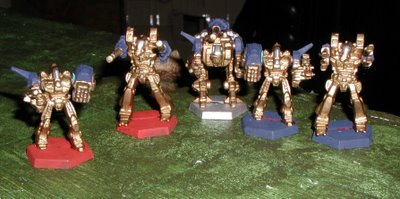
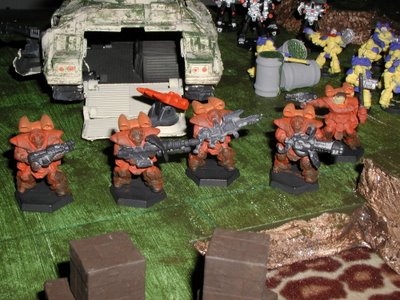

But you start with nothing. Well a few unpainted miniatures. So far I have 2 squads of IG Legionnaires, 2 squads of Mecks, 1 squad of Space Orx, 1 squad of Reaction Marines, a deathball and 2 painted NRAAVs. I'm including some of the pics so you can see just how much work goes into this game. I now have a pile of terrain bits including a very cool water treatment facility, terrain with an unexploded bomb in it and tonnes of little bits and pieces. I'll soon be done the last few pieces of terrain so that I can clean up my modelling stuff to finally regain my music room.


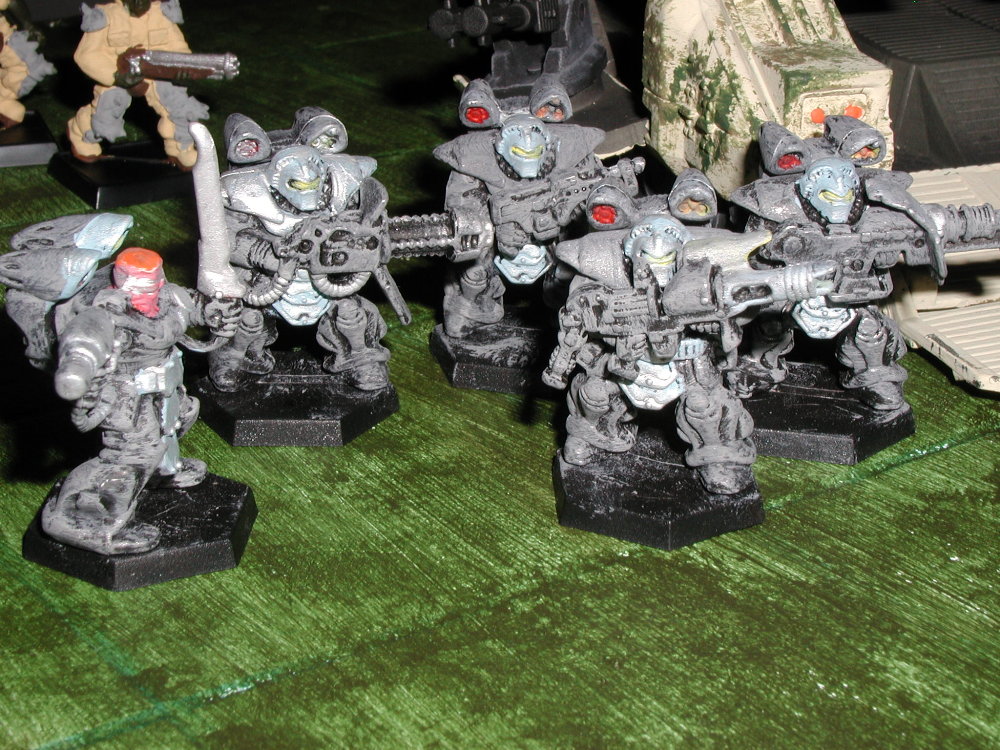

Letter to a Fundamentalist
Michael Pahl wrote this excellent open letter that deals with the issue of scriptural inspiration. It is worth reading and digesting. I know myself that dialogues with my fundamentalist friends have been painful and I imagine a letter like this is really only well recieved by the already convinced. Maybe it will help us to be a little more merciful to our fundamentalist brothers and sisters.
Thursday, July 20, 2006
[THO] Liturgical Trappings
Over an Ben Myer's blog there is a poll on what is the worst liturgical invention! What an interesting topic it has been, last I checked he ahd garnered 72 comments (only about 4 were me before you ask). What really struck me is that "tiny communion cups" is leading! Yeah, those silly little grape juice recepticles so common in the Church today. Is this further evidence of a real Eucharistic renewal in the Church? I sure hope so. Some of the early comments are priceless, like the guy who witnessed fat men in tights doing liturgical dance - yeah I know you want to rip your eyes out just reading about such a thing. Although I often suspected this is something that went on in freemasonry.
So what do you think is the best liturgical invention? It could be from any era, but something that was introduced into the church and just makes a lot of sense. If I get enough variety I'll make up a poll.
Tuesday, July 18, 2006
[LIF] Life is Busy
One of my friends once tried to tell me that being busy is a bondage. I tend to agree, but I am not sure what to do about it. Life just gets that way. Especially when you have two kids and a wife, a church to pastor, great friends and hobbies. It seems I get through one busy spell, catch my breath and hit another.
Right now we are preparing for our family vacation and a friend asked me to write and article for Christian Week. How could I turn that down? I also promised to write a new scenario for D&D miniatures before I left, I have a contract to write for them which is a lot of fun but a lot of work. And I am still preparing my liturgy for tomorrow night.
I spent the day at a local gaming store, with my oldest daughter of course, to run games for a D&D club there. Well none of the D&D club showed up but one young guy was interested and played against my daughter. She kicked his butt in Skullrunner, a little scenario I wrote. After that we hung out and played Pokemon, she kicked my butt. I got home and Sharon had made supper for a change, I'm the usual cook in the home and after supper I had a brief chance to read (Volf) while the kids played in the backyard. Sharon was off with her boss negotiating hours for this coming September. I just got the kids down and am free to work but what do I do - yeah I came here to type this up.
Well, best stop dallying. If I don't post as frequently in the next little while it is because I am busy.
Right now we are preparing for our family vacation and a friend asked me to write and article for Christian Week. How could I turn that down? I also promised to write a new scenario for D&D miniatures before I left, I have a contract to write for them which is a lot of fun but a lot of work. And I am still preparing my liturgy for tomorrow night.
I spent the day at a local gaming store, with my oldest daughter of course, to run games for a D&D club there. Well none of the D&D club showed up but one young guy was interested and played against my daughter. She kicked his butt in Skullrunner, a little scenario I wrote. After that we hung out and played Pokemon, she kicked my butt. I got home and Sharon had made supper for a change, I'm the usual cook in the home and after supper I had a brief chance to read (Volf) while the kids played in the backyard. Sharon was off with her boss negotiating hours for this coming September. I just got the kids down and am free to work but what do I do - yeah I came here to type this up.
Well, best stop dallying. If I don't post as frequently in the next little while it is because I am busy.
Sunday, July 16, 2006
[LIF] Doing the Stuff
Yesterday I spent the whole day at Joy Jam. This is my third year playing the Joy Jam festival and the third year our church, Freedom Vineyard, has donated water and helping hands to make this outreach a lot of fun. Brainchild of Matthew from Capital City Mission, Joy Jam wants to become Cornerstone North. We've had the joy of being there from the start! This is a day of free food, kids activities and music in an inner-city park surrounded by some of the poorest of Ottawa. Going out each year, and connecting with Capital City Mission through the year I'm starting to get to know some of the folks down there. There are a few old friends from my street preaching days, one friend in particular who always enjoys my music!
I was the last act to play. I got to close out the day which was both cool and a bit stressful. I had arranged to play with another guy, we had even worked up a set of music, but life conspired against us. Then I set up a background vocalist to at least make me sound good - and she had to bail on me as well. So I was guy with guitar. But it was fun. I even had some lady sitting right up front her eyes closed listening to every song, that was encouraging.
A lot of the acts were gospel music, and the first guy to play had a really great voice. Matthew's band, that he wants to name "Smells like Skunk", were pretty good doing all original pieces, they have a nice grungy sound. Then the main act was from Sudbury, the Mission Jam Band which were pretty good blues players. They let me into the tent just after 7 and by 7:15 I had my guitars by my side, a mic in front of me and I was ready to play. I started with "Let it Rain" which really needs Amanda Marshall to pull off, I was a bit fast but it gave me a chance to get my sound. I then launched into Rik Leaf's "Everyday" a song I always do down there. I did "Won't Back Down" which people loved, I do a fun version of that one that people asked me for before I went up. Then I grabbed my wife's guitar all tuned up in open E for a little Stones, "You Can't Always Get What You Want." That was my first time playing that song live, it was better with Nancy's BGVs but enjoyable none-the-less. Then I did my country set (smile), the Choir's "Behind that Locked Door" then to Andrew Smith's "I Come Undone". Then I did an original called "Fever", I think I've done that one somewhere else live. And at this point time is getting on so I finish up with "Heart of Gold".
I was the last act to play. I got to close out the day which was both cool and a bit stressful. I had arranged to play with another guy, we had even worked up a set of music, but life conspired against us. Then I set up a background vocalist to at least make me sound good - and she had to bail on me as well. So I was guy with guitar. But it was fun. I even had some lady sitting right up front her eyes closed listening to every song, that was encouraging.
A lot of the acts were gospel music, and the first guy to play had a really great voice. Matthew's band, that he wants to name "Smells like Skunk", were pretty good doing all original pieces, they have a nice grungy sound. Then the main act was from Sudbury, the Mission Jam Band which were pretty good blues players. They let me into the tent just after 7 and by 7:15 I had my guitars by my side, a mic in front of me and I was ready to play. I started with "Let it Rain" which really needs Amanda Marshall to pull off, I was a bit fast but it gave me a chance to get my sound. I then launched into Rik Leaf's "Everyday" a song I always do down there. I did "Won't Back Down" which people loved, I do a fun version of that one that people asked me for before I went up. Then I grabbed my wife's guitar all tuned up in open E for a little Stones, "You Can't Always Get What You Want." That was my first time playing that song live, it was better with Nancy's BGVs but enjoyable none-the-less. Then I did my country set (smile), the Choir's "Behind that Locked Door" then to Andrew Smith's "I Come Undone". Then I did an original called "Fever", I think I've done that one somewhere else live. And at this point time is getting on so I finish up with "Heart of Gold".
Friday, July 14, 2006
[LIF] My Pocketbook Does Not Like Kenny!
I found All Books today. All I can say is wow. I managed to get out of there having only spent ~$40. This is what I scored:
The Portable Nietzsche (Viking Edition, the very one I was looking for and for like $8)!
Hegel's Philosophy of Right (Yeah I know, I couldn't remember if this was the one I had and it was. Downer. But it was only $10)
Heidegger Basic Writings (Oh yeah baby! I defintely want the copy of Being and Time they had there but this one sold me as it starts with What is Metaphysics. Yeah I know these are online but a book is so much nicer than a printout)
Beyond Good and Evil (Nietzsche) The one Nietzsche I wanted that isn't in the Portable Reader.
Kenny you need Hegel?
The Portable Nietzsche (Viking Edition, the very one I was looking for and for like $8)!
Hegel's Philosophy of Right (Yeah I know, I couldn't remember if this was the one I had and it was. Downer. But it was only $10)
Heidegger Basic Writings (Oh yeah baby! I defintely want the copy of Being and Time they had there but this one sold me as it starts with What is Metaphysics. Yeah I know these are online but a book is so much nicer than a printout)
Beyond Good and Evil (Nietzsche) The one Nietzsche I wanted that isn't in the Portable Reader.
Kenny you need Hegel?
Thursday, July 13, 2006
[THO] Convenential Extremes
There are a lot of ideas in popular Christianity that are quite disturbing when you think them through. Most of this poor theology comes out of a singularity of focus and a utilitarian approach to scripture. I want to explore both of these thoughts in relationship to what I call extreme covenent theology.
When we focus on anything to the exclusion of all else we create an object of worship out of that thing (which could be an idea or a practice as easily as it could be a physical object). And when that thing is anything but God then the imbalance leads us into strange places. This happens when we place a particular practice at the front of our theological musings as I have been recently discussing with regard to the affection of tongues over on Joe's blog. In a covenential setting it is seeing covenant as the defining quality of our relationship to God that creates the most trouble. When covenant takes the place of the mediation of Christ then we are thrown into a legalistic framework. Both God and man seem to be bound by the rules of this framework, and what gets espoused by proponents of this thinking is that if we pray just the right way, or give the right way, or even witness the right way then God is forced to respond in a pre-determined fashion. This smacks of witchcraft when we think about it.
God cannot be forced to heal, forgive, bend the laws of reality or anything we might try to manipulate God into doing. If this were the case then somehow the creation has gotten the upper hand on the Creator and the last time I read the bible God was still King and on the throne. But isn't that just easier to relate to than a God who freely gives, freely forgives (even folks we secretly don't want forgiven) and even freely heals?
The second problem stems from an approach to scripture that I would define as utilitarian, but might also be appropriately named instrumentalistic. Seeing Scripture as a series of "priciples" that when applied in just the right way will affect the desired results. Again this smacks of witchcraft.
Proponents of such theologies tend towards endless prooftexting to build their "principles". Often building an entire theology from one or two verses lifted entirely from their context. This type of thing always makes me cringe, and for good reason. It completely misses the point. Scripture is not some magic spell that makes God dance to our beat. On the contrary Scripture beats out the heartbeat of God so that we can join the dance that God has initiated. It is the story we find ourselves in, not the one we get to rewrite basd on our percieved needs and twisted desires.
Sometimes that song is disturbing to us. I know recently the dance has been hard because reading Volf's Exclusion and Embrace has been uncovering some real unchristlike aspects of my life. But there is no magic mantra in the bible that I can say to make that go away. Rather I am drawn into the dance that takes me into these places so that with God, as my dance partner, we can begin the hard work of salvation deeper and deeper in my soul.
So next time someone tells you to pray this way or follow this principle. listen for the drumbeat of God. That one might not sound as enticing, but trust me it is the one that will change your life. Sure I believe in covenants, but the one covenant that matters is what Jesus did for me on the cross. And that one lets me dance the dance that God has begun. That one removes me from the legalistic frameworks that can never lead to life. That covenant leads to freedom.
When we focus on anything to the exclusion of all else we create an object of worship out of that thing (which could be an idea or a practice as easily as it could be a physical object). And when that thing is anything but God then the imbalance leads us into strange places. This happens when we place a particular practice at the front of our theological musings as I have been recently discussing with regard to the affection of tongues over on Joe's blog. In a covenential setting it is seeing covenant as the defining quality of our relationship to God that creates the most trouble. When covenant takes the place of the mediation of Christ then we are thrown into a legalistic framework. Both God and man seem to be bound by the rules of this framework, and what gets espoused by proponents of this thinking is that if we pray just the right way, or give the right way, or even witness the right way then God is forced to respond in a pre-determined fashion. This smacks of witchcraft when we think about it.
God cannot be forced to heal, forgive, bend the laws of reality or anything we might try to manipulate God into doing. If this were the case then somehow the creation has gotten the upper hand on the Creator and the last time I read the bible God was still King and on the throne. But isn't that just easier to relate to than a God who freely gives, freely forgives (even folks we secretly don't want forgiven) and even freely heals?
The second problem stems from an approach to scripture that I would define as utilitarian, but might also be appropriately named instrumentalistic. Seeing Scripture as a series of "priciples" that when applied in just the right way will affect the desired results. Again this smacks of witchcraft.
Proponents of such theologies tend towards endless prooftexting to build their "principles". Often building an entire theology from one or two verses lifted entirely from their context. This type of thing always makes me cringe, and for good reason. It completely misses the point. Scripture is not some magic spell that makes God dance to our beat. On the contrary Scripture beats out the heartbeat of God so that we can join the dance that God has initiated. It is the story we find ourselves in, not the one we get to rewrite basd on our percieved needs and twisted desires.
Sometimes that song is disturbing to us. I know recently the dance has been hard because reading Volf's Exclusion and Embrace has been uncovering some real unchristlike aspects of my life. But there is no magic mantra in the bible that I can say to make that go away. Rather I am drawn into the dance that takes me into these places so that with God, as my dance partner, we can begin the hard work of salvation deeper and deeper in my soul.
So next time someone tells you to pray this way or follow this principle. listen for the drumbeat of God. That one might not sound as enticing, but trust me it is the one that will change your life. Sure I believe in covenants, but the one covenant that matters is what Jesus did for me on the cross. And that one lets me dance the dance that God has begun. That one removes me from the legalistic frameworks that can never lead to life. That covenant leads to freedom.
Monday, July 10, 2006
[FUN] All of Tübingen is celebrating!
Bringing home the victory to Germany it is Jürgen Moltmann! Jubilant crowds could care less about the huge airship darkening the stadium, crowds of theologians, wannabe theologians, liturgicists, feminists, philosophers, scholars and the like are dancing it up on the field. Balthasar gracefully embraced Moltmann with a look of, "we'll have to see about next century!"
No news yet as to the mystery of the kiwi or the huge blimp hovering above the Finnish stadium. Updates to follow!
No news yet as to the mystery of the kiwi or the huge blimp hovering above the Finnish stadium. Updates to follow!
Sunday, July 09, 2006
[FUN] Huge Koala Blimp heading towards Finland!
Seems that the excitement in Germany over some other World Cup had distracted our infamous Koala villian, but the blimp is back! Must be awaiting the fierce knock-down drag-out fight going on between Von Balthasar and Moltmann. My Molty is looking spiffy tonight! Looks like this is one match that won't need to go to a penalty kick-off. But still what could be up with airship?
[UPDATE]
As the airship overshadowed the battle arena the crowd was bombarded with a booming slightly femine voice: "Who wins here faces me in Australia or I will reveal the secret of the kiwi fruit to the world!" Thirty minutes of insane laughter followed during which the contestants shrugged and began to match words, thoughts and influence in the ring!
Note supporters of von Balthasar have tried to invoke penalty after penalty, attacking the very questions at stake. It would seem vonB plays like the Italians play soccer! Perhaps he spent time in the Swiss guard, protecting the Pope in the Vatican? It is oh so confusing. Perhaps it is merely that his supporters want to win this one like they won the "other" World Cup!
[UPDATE]
As the airship overshadowed the battle arena the crowd was bombarded with a booming slightly femine voice: "Who wins here faces me in Australia or I will reveal the secret of the kiwi fruit to the world!" Thirty minutes of insane laughter followed during which the contestants shrugged and began to match words, thoughts and influence in the ring!
Note supporters of von Balthasar have tried to invoke penalty after penalty, attacking the very questions at stake. It would seem vonB plays like the Italians play soccer! Perhaps he spent time in the Swiss guard, protecting the Pope in the Vatican? It is oh so confusing. Perhaps it is merely that his supporters want to win this one like they won the "other" World Cup!
[LIF] Minidisc Decisions

I am really cued to sound, especially music. I prefer the silence of a library, but end up doing most of my reading in coffee shops or late at night in my house. Unfortunatly that isn't giving me enough reading time, not to mention it makes me tired. Sometimes the coffee shop is too noisy. But I noticed something. It isn't the music, it is the lyrics. I am obsessed with listening to the lyrics! When it is just music then I am fine to read, in fact the pace helps me move along. But as soon as a song is sung I am distracted. Funny I can tune out the conversations of most strangers, but not my family. And I can tune out music, just not lyrics.
So I have an idea. I have a minidisc player and a couple great sets of ear cans! Those headphones that cover your whole ear - I have them from my home music studio. So now I have to programme a couple of these discs for the coming reading year. On one I want fairly contemporary stuff, both need to have consistent sound levels (not a lot of volume modulations) and the contemporary stuff needs to have a decent, but not too fast pace. I'm into everything from Portishead to Folk Rock, but I don't do classical music (sadly bad associations with my past has wrecked my capacity to enjoy classical music).
I want to throw it open to suggestions: Please indicate disc A (contemporary) or disc B (ecclectic). Also please make many suggestions for both. I believe in paying for my music so the more stuff I can get from say buying a compilation CD the better. I'm looking forward to your suggestions.
Thanks in advance!
Saturday, July 08, 2006
[DDM] Bahamut Baby!!!
 Yesterday I arrived home from the game store with 18 cases of freshly released War of the Dragon Queen Miniatures! OK before you freak, only 3 of them where for me. It was a lot of fun to watch my gamer friends come by and grab their cases. After supper a few of my friends came over to play a sealed event - that is you grab two unopened boosters and make a 500pt warband from the minis inside. I opened my first booster and it was the Aspect of Tiamat, I knew this was going to be fun! Second booster - Aspect of Bahamut! Holy crap I pulled the two fiercest rares in the set! Unfortunately they both don't fit. I had a tough decision so I finally went with Bahamut (pictured) and built my band.
 Because of the excitement of people coming by and opening up their boosters we only got to play two games. The first one I decimated Greg's Sorceror on Black Dragon and Tordek band. He really rolled poorly on saves which made the game go really fast! The second matchup was against Jay with his Godslayer band. That was the only piece I was afraid of, it has a major hate on for the Aspects. He managed to confuse both my Fang Dragon and my Nightmare! But in the end I beat him with points. Jay has improved his play considerably, but he has also slowed down his play which I think cost him the game. All in all it was a fun night.
From my three cases, and a little trading, I pulled all the huge minis. I also snagged most of the rares I really wanted including 2 Cadaver Collectors! I need a few more Griffon Calvary but judgeing by how much people wanted them in our group, I might have some difficulty getting more than the one I pulled (first mini I pulled out actually). My girls helped me open the first two cases that afternoon, which was fun. Elyssa thought the Aspect of Tiamat looked so beautiful that she was crying happy tears when she saw it. My wife just thought it looked creepy.
[FUN] Moltmann!!!!
The crowd on either side is roaring their excitement. Each contestant has come out dressed in their fighting shorts and tees! Moltmann cuts a dashing figure as he rushes into the arena and looks to find his gladiatorial weapon of choice - this is serious theology folks! He eyes the Sword of the Spirit but opts for the Trinitarian trident of Immenant Social Might (+5 for you game nuts). Von Balthasar hefts a mighty mitre of Peter (+3 Holy weapon) and steps into the Ring of Decision. A bell rings out from Finland to the world and the frey begins! This is going to be fierce people, hold on to your hats!
Rahner kicked Jenson right out of the ring last match securing a solid bronze finish.
Rahner kicked Jenson right out of the ring last match securing a solid bronze finish.
Friday, July 07, 2006
[FUN] We have finalists!
It is down to the wire are the World Cup of Modern Systematic Theologians! Battling it out for third and fourth place we have Lutheran Robert Jensen, the only Anglophone to make it that far and Roman Catholic giant Karl Rahner!
von Balthasar knocked out Jensen to earn the match against Moltmann coming up. That should prove to be exciting as both theologians seem to have a strong following amongst the blogizens.
von Balthasar knocked out Jensen to earn the match against Moltmann coming up. That should prove to be exciting as both theologians seem to have a strong following amongst the blogizens.
Thursday, July 06, 2006
Wednesday, July 05, 2006
[FUN] Moltmann rocks the WCoMST!
This just in, Moltmann has kicked the crap out of Rahner! It is true, he had him up against the ropes just pounding away. Rahner put up a pretty consistent defence but was no match for the awesome creative force of Moltmann!
If I were into tattoos I'd get the letters TATK across my knuckles in honour of the event!!!!!
If I were into tattoos I'd get the letters TATK across my knuckles in honour of the event!!!!!
Tuesday, July 04, 2006
[LIF] OK This is Annoying
What the heck is Harper thinking with this? My buddy Joseph was ranting about this in his Coffee Jesus. I had to look it up, sadly I find the news depressing and this is a case in point. Now don't get me wrong, I am not a fan of Mr. Harper but still I didn't expect him to do something as stupid as this. Did I suddenly wake up in the States?
I just don't get it. Especially with someone who wants to win a majority government in the next election - you would think they wouldn't want to alienate a huge portion of Canada's population, let alone one that many of us feel have been trodden under the boot of the "white" man for too many years now. Just frustrating. Perhaps George Bush will be relieved that his position as my least favourite world leader is being challenged.
I just don't get it. Especially with someone who wants to win a majority government in the next election - you would think they wouldn't want to alienate a huge portion of Canada's population, let alone one that many of us feel have been trodden under the boot of the "white" man for too many years now. Just frustrating. Perhaps George Bush will be relieved that his position as my least favourite world leader is being challenged.
[LIF] Books!

Paid a visit to the local used book store and bought my very first Hegel! I also picked up Bibby's Unknown Gods which should be fun. I am pretty excited to actually have the dreaded Hegel on my shelf. I was hoping to pick up some use Nietzsche but alas none was to be found.
Currently I am reading Miroslav Volf's Exclusion and Embrace which is incredibly profound. I find that it is uncovering my own patterns of exclusion, especially in regard to how I construct my own identity. I am not liking what I see but the book is just starting and I think is going to be a good partner through a difficult personal journey. BTW Volf's Free of Charge is an incredibly worthwhile read! On the go I always have something from Moltmann, still The Crucified God. And devotionally I have added Nouwen's With Burning Hearts to my lectional readings, this is the book I would love to use as an intro for a course on Eucharistic Imagination.
I am thinking of constructing a Reading List, what I would like to read next. I'm just going to deal with books on my shelf already and give preference to books I've either started or haven't touched yet.
Thinking Biblically Ricoeur & LaCoque (started, need to finish)
The Idea of the Holy Otto (have picked at, but always wanted to sink my teeth into)
Philosophy of the Right Hegel
In Memory of Her Fiorenza
Religion Within the Boundaries of Mere Reason Kant
Theology of Hope Moltmann
The Rule of Metaphor Ricoeur
The Future of Hope Volf & Katerberg (read the Moltmann essay only so far)
Followers of Jesus Vanier
The Gospel of the Kingdom Ladd (I've never finished this one)
That should keep me busy a while. Of course this goes out the window as new books come into my house.
[FUN] WCoMST Getting down to the wire
Reports of Moltmann practice sparring with Walter Kasper tell us that the upcoming heat against Karl Rahner will prove very, very exciting!
Yes, we have it folks. Moltmann has stepped into the ring with Rahner! This is going to be a matchup that will reverberate through the ages! Moltmann is creatively jabbing at Rahner while Rahner consistently blocks the blows. I think his consistency will be a liability soon, yes, Moltmann has figured out the pattern of Rahner's defense. That mighty blow of influence has Rahner reeling! This is a grand fight folks! a grand fight!
Down on the pitch von Balthasar is still jostling with Pannenberg. Results to follow soon. Pannenberg seems to have taken an injury early on, we'll see how he fares at the end of that matchup.
[UPDATE]
Towards the end of the match, von Balthasar shouted "take this protestant boy!" as he scored the winning goal!
Yes, we have it folks. Moltmann has stepped into the ring with Rahner! This is going to be a matchup that will reverberate through the ages! Moltmann is creatively jabbing at Rahner while Rahner consistently blocks the blows. I think his consistency will be a liability soon, yes, Moltmann has figured out the pattern of Rahner's defense. That mighty blow of influence has Rahner reeling! This is a grand fight folks! a grand fight!
Down on the pitch von Balthasar is still jostling with Pannenberg. Results to follow soon. Pannenberg seems to have taken an injury early on, we'll see how he fares at the end of that matchup.
[UPDATE]
Towards the end of the match, von Balthasar shouted "take this protestant boy!" as he scored the winning goal!
Sunday, July 02, 2006
[FUN] WCoMST Continues
Yesterday we saw Rahner take to the field with J�ngel, and only one will emerge victorious. Rahner has been dominating that match, but it's not over until the Finnish man sings!
Not surprisingly Moltmann handily defeated the bishop of Rome. Those Swiss guards were no match for Moltmann's feminist legionnaires, all sporting spiffy bushy eyebrows. Suspiciously absent from that crowd was Mary Daly? In any case they were successful at preventing any violence from breaking out and promptly decided to change their name from legionnaires to "peer support group". Ratzinger took up his mitre and jumped in the awaiting Popecopter, heading towards Rome. Guess he has some business to take care of - we knew he wasn't going to stick around to cheer on Rahner.
[UPDATE]

Two theologians I know pretty much nothing about are duking it out! Gunton and Jenson (pictured above) - I'm following the comments to see if I can glean anything about them.
Meanwhile Rahner was awarded the victory! Despite the claims that he has led many astray, it seems Rahnger himself knows how to get out of the J�ngel!
Not surprisingly Moltmann handily defeated the bishop of Rome. Those Swiss guards were no match for Moltmann's feminist legionnaires, all sporting spiffy bushy eyebrows. Suspiciously absent from that crowd was Mary Daly? In any case they were successful at preventing any violence from breaking out and promptly decided to change their name from legionnaires to "peer support group". Ratzinger took up his mitre and jumped in the awaiting Popecopter, heading towards Rome. Guess he has some business to take care of - we knew he wasn't going to stick around to cheer on Rahner.
[UPDATE]
Two theologians I know pretty much nothing about are duking it out! Gunton and Jenson (pictured above) - I'm following the comments to see if I can glean anything about them.
Meanwhile Rahner was awarded the victory! Despite the claims that he has led many astray, it seems Rahnger himself knows how to get out of the J�ngel!
Saturday, July 01, 2006
[LIF] Canada Day
HAPPY
CANADA
DAY!
Off to spend time with family and friends, and hopefully see some fireworks with my oldest daughter. Rahner and Jüngel can wait...
Friday, June 30, 2006
[FUN] What we have been all waiting for...
Moltmann vs. Ratzinger
This is the big one folks. The crowd is immense today as these giants take to the field. Moltmann has come out swinging and Ratzinger has thrown down his miter to engage in theological hand-to-hand combat.
I really think this is no contest if you weigh both on the merits of their theological contributions, but being made Pope does tend to grant a degree of celebrity to a person.
Just to get you all caught up:
von Balthasar decimated Lubac.
Pannennberg destroyed Frei.
Brackets can be seen here.
This is the big one folks. The crowd is immense today as these giants take to the field. Moltmann has come out swinging and Ratzinger has thrown down his miter to engage in theological hand-to-hand combat.
I really think this is no contest if you weigh both on the merits of their theological contributions, but being made Pope does tend to grant a degree of celebrity to a person.
Just to get you all caught up:
von Balthasar decimated Lubac.
Pannennberg destroyed Frei.
Brackets can be seen here.
Wednesday, June 28, 2006
[FUN] Catholics and Protestants Unite..Please
The debate rages over the impact of modern day ultramontanism in the World Cup of Modern Systematic Theologians. The controversy arose over the posting of links to the contest to several Ratzinger fan sites - yeah I had no idea either. The concern is that Ratziner as Pope Benedict has more traction then he did as Cardinal. I also can't get over that he gave some of my homeboys at Tübingen a hard time! But, that is really just water under the bridge now.
Moltmann took his heat against Congar, despite the Ratz-pack coming in at the last minute to support their Roman brother.
And Ratzinger dominated Gutierrez with the help of his Swiss guard and fans. Also it must have something to do with having much less creepy lips than Gutierrez.
Today two new heats began:
Jenson emerged onto the pitch with Tillich, someone is getting ripped a new one as the battle of the Lutherans begins!
And sporting spiffy well trimmed beards, Gunton and Zizioulas face off.
[UPDATE]
Looks like Niebuhr will have to accept the things he cannot change as the mighty Jüngel has prevailed.
Rahner showed Torrance what's what in their match, but will he be able to defeat the Jüngel?
Moltmann took his heat against Congar, despite the Ratz-pack coming in at the last minute to support their Roman brother.
And Ratzinger dominated Gutierrez with the help of his Swiss guard and fans. Also it must have something to do with having much less creepy lips than Gutierrez.
Today two new heats began:
Jenson emerged onto the pitch with Tillich, someone is getting ripped a new one as the battle of the Lutherans begins!
And sporting spiffy well trimmed beards, Gunton and Zizioulas face off.
[UPDATE]
Looks like Niebuhr will have to accept the things he cannot change as the mighty Jüngel has prevailed.
Rahner showed Torrance what's what in their match, but will he be able to defeat the Jüngel?
Tuesday, June 27, 2006
[FUN] Still Awaiting the final results
Moltmann is holding his ground with Congar in a fierce battle.
Ratzinger has called in his secret Swiss Infiltration units to boost his votes almost guaranteeing his win against Gutierrez. This was almost as unexpected as the Spanish Inquisition!
As we await these games to be called two other matches have begun.
Rahner has taken to the pitch against Torrance. Rahner is a veritable juggernaut who is used to being taken on in the theological arena, just ask Metz! Currently he is wiping the floor with Torrances shiny white collar!
Jüngel has thrown down with Reinhold, who says I'm lesser now punk, Niebuhr! You can bet he will help Jüngel to accept the things he cannot change in this showdown!
Updates to follow.
Ratzinger has called in his secret Swiss Infiltration units to boost his votes almost guaranteeing his win against Gutierrez. This was almost as unexpected as the Spanish Inquisition!
As we await these games to be called two other matches have begun.
Rahner has taken to the pitch against Torrance. Rahner is a veritable juggernaut who is used to being taken on in the theological arena, just ask Metz! Currently he is wiping the floor with Torrances shiny white collar!
Jüngel has thrown down with Reinhold, who says I'm lesser now punk, Niebuhr! You can bet he will help Jüngel to accept the things he cannot change in this showdown!
Updates to follow.
Monday, June 26, 2006
[FUN] The Battle Continues
The crowds cheer wildly as the final contestants walk onto the pitch. Dressed in full Papal splendor, Benedict nee Ratzinger steps up to the microphone, ready to do battle with Gutierrez. The Swiss guard surrounds the field as these two giants begin to gather the votes that will either sweep them into victory or relegate them to the sidelines of this important match!
On the other pitch, Moltmann, looking strong but tired from chairing a recent symposium, steps up to his microphone. His mind sharp and ready to decimate his robed opponent Yves Congar. Moltmann issues his first piercing question and the duel begins!
Patrik has offered brackets here for those following the game.
On the other pitch, Moltmann, looking strong but tired from chairing a recent symposium, steps up to his microphone. His mind sharp and ready to decimate his robed opponent Yves Congar. Moltmann issues his first piercing question and the duel begins!
Patrik has offered brackets here for those following the game.
Subscribe to:
Posts (Atom)